
2018-2019 Microsoft MVP Award


With great joy and honor I can announce that I have been awarded the Microsoft Most Valuable Professional Award in the category Office Servers and Services (localized e-mail):
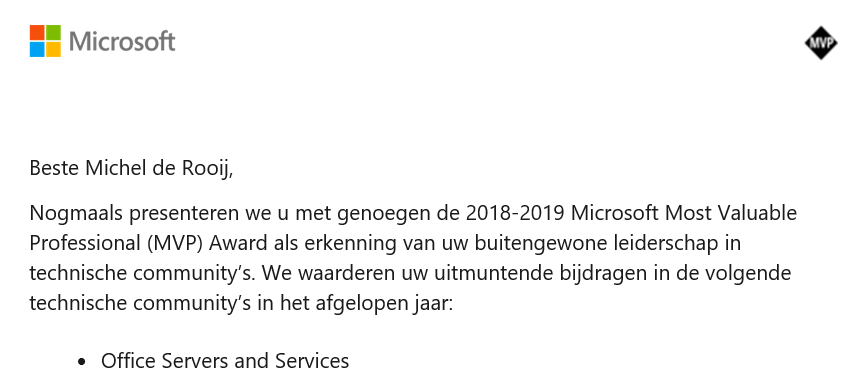
image

MVP awards are given to individuals by Microsoft in recognition of their contributions to the community, such as:

  • Writing blogs, articles, books.
  • Speaking engagements or podcasts.
  • Supporting others, e.g. forum or TechCommunity contributions.
  • Code contributions.
  • Product feedback.

This is my 5th consecutive year as an MVP. I used to be an “October MVP”, which meant my award was up in October every year. After the award cycle changed to a yearly one for everyone, this year was the first time all MVP’s who fell under the old quarterly cycles, were being up for renewal. It also meant, contributions of a longer period of time were being evaluated. So lots of kudos to the MVP leads and other folks that had to go through the monstrous task of reviewing thousands of contributions for this cycle.

Many thanks to the community, readers, followers, fellow MVP’s and friends, peers, product groups and other Microsoft employees for their encouragement, inspiration and support over all those years.

My MVP profile can be found here.

Exchange Updates – June 2018


Ex2013 LogoThe Exchange Team released the June updates for Exchange Server 2013 and 2016, and an additional Rollup 22 for Exchange Server 2010 Service Pack 3.

Apart from fixes and time zone changes, these updates contain the following important changes and notes:

  • As announced earlier, Exchange 2013 CU21 and Exchange 2016 CU10 require .NET Framework 4.7.1.
  • All three updates require the VC++ 2013 runtime library, because it is needed by a 3rd component in WebReady Document Viewing in Exchange 2010/2013 and Data Loss Prevention in Exchange 2013/2016. Exchange 2010 SP3 RU22 will force installation of this VC++ runtime.
  • Updates include a critical security patch for Oracle Outside In libraries. More about the issue in MSRC advisory ADV180010.
  • Exchange 2013 CU21 and Exchange 2016 CU10 introduce support for directly creating and enabling remote shared mailboxes, e.g.
    New-RemoteMailbox [-Shared] [-Name remoteMailboxName]
    Enable-RemoteMailbox [-Identity user] [-Shared] [-RemoteRoutingAddress user@domain]
    Set-RemoteMailbox [-Name user] [-Type Shared]

    You need to run setup /PrepareAD to see these changes. More information in KB4133605.

  • This is the last planned Cumulative Update for Exchange 2013 as it enters Extended Support.
  • Exchange 2010 SP3 RU22 adds support for Windows Server 2016 Domain Controllers.


Version Build KB Article Download UMLP Schema Changes
Exchange 2016 CU10 15.1.1531.3 KB4099852 Download UMLP No
Exchange 2013 CU21 15.0.1395.4 KB4099855 Download UMLP No
Exchange 2010 SP3 RU22 14.3.411.0 KB4295699 Download

Exchange 2016 CU10 fixes:

  • 4056609 Event ID 4999 and mailbox transport delivery service won’t start with Exchange Server 2016 CU7 installed
  • 4133605 Cmdlets to create or modify a remote shared mailbox in an on-premises Exchange environment
  • 4133620 “HTTP 500 due to ADReferralException” error when a user tries to view detail properties of mailboxes in a child domain in Exchange Server
  • 4095974 “System.InvalidOperationException” occurs when the “Enable-MailPublicFolder” cmdlet is run against a public folder in Exchange Server
  • 4095973 Set-ServerComponentState cmdlet does not honor the write scope defined in the RBAC management scope in Exchange Server
  • 4095993 HTTP 500 error when an administrator tries to manage regional settings in ECP on Windows Server 2016
  • 4294209 Cannot clear the “Maximum message size” check box for Send messages or Receive messages in EAC in Exchange Server 2016
  • 4294208 “TooManyObjectsOpenedException” error when you run the “Get-PublicFolderMailboxDiagnostics” cmdlet in Exchange Server
  • 4294212 Cannot send VBScript-created messages in the Outlook 2016 client
  • 4294211 Cannot run “Set-CalendarProcessing” cmdlets after you apply CU8 or CU9 for Exchange Server 2016
  • 4294210 Cannot edit an email attachment in OWA in an Exchange Server 2016 environment
  • 4294204 Changing “IsOutOfService” to “False” in an earlier Exchange Server version does not immediately update in a later Exchange Server environment
  • 4092041 Description of the security update for Microsoft Exchange Server 2013 and 2016: May 8, 2018

Exchange 2013 CU20 fixes:

  • 4133605 Cmdlets to create or modify a remote shared mailbox in an on-premises Exchange environment
  • 4133604 User can’t log on to a POP/IMAP account by using NTLM authentication in Exchange Server 2013
  • 4133618 Unexpected error occurs when running the Get-DatabaseAvailabilityGroupNetwork cmdlet in Exchange Server 2013
  • 4133620 “HTTP 500 due to ADReferralException” when a user tries to view detail properties of mailboxes in a child domain in Exchange Server
  • 4058473 An Office 365 primary mailbox user cannot be assigned full access permissions for an on-premises mailbox in Exchange Server
  • 4094167 The MSExchangeRPC service crashes with a System.NullReferenceException exception in Exchange Server 2013
  • 4095974 “System.InvalidOperationException” occurs when the “Enable-MailPublicFolder” cmdlet is run against a public folder in Exchange Server
  • 4092041 Description of the security update for Microsoft Exchange Server 2013 and 2016: May 8, 2018
  • 4294205 POP3 services intermittently stop in an Exchange Server 2013 environment
  • 4294204 Changing “IsOutOfService” to “False” in an earlier Exchange Server version does not immediately update in a later Exchange Server environment

Exchange 2010 Rollup 22 fixes:

  • 4295751 EWS impersonation not working when accessing resource mailboxes in a different site in Exchange Server 2010 SP3

Notes:

  • Exchange 2016 CU8 and Exchange 2013 CU18 do not contain schema changes compared to their previous Cumulative Update. However, they introduce RBAC changes in your environment. Use setup /PrepareAD to apply RBAC changes, before deploying or updating Exchange servers.
  • When upgrading from an n-2 or earlier version of Exchange, or an early version of the .NET Framework, consult Upgrade Paths for CU’s & .NET.
  • When upgrading your Exchange 2013 or 2016 installation, don’t forget to put the server in maintenance mode when required. Regardless, setup will put the server in server-wide offline mode post-analysis, before making actual changes.
  • When using Exchange hybrid deployments or Exchange Online Archiving (EOA), you are required to stay at most one version behind (n-1).
  • If you want to speed up the update process for systems without internet access, you can follow the procedure described here to disable publisher’s certificate revocation checking.
  • Cumulative Updates can be installed directly, i.e. no need to install RTM prior to installing Cumulative Updates.
  • Once installed, you can’t uninstall a Cumulative Update nor any of the installed Exchange server roles.
  • The order in which you upgrade servers with Cumulative Updates is irrelevant.

Caution:

As for any update, I recommend to thoroughly test updates in a test environment prior to implementing them in production. When you lack such facilities, hold out a few days and monitor the comments on the original publication or forums for any issues.

Automation, DevOps and the Evolution of the IT Pro


iTunes-Podcast-logo[1]Recently, Simon Waight and I were invited by fellow MVP Chris Goosen from Cloud Architects to come chat a little on Automation, DevOps and the evolution of the IT Professional.

With the bridge narrowing between development and infrastructure on a daily basis, and infrastructure becoming code, the DevOps culture is becoming more and more important to be knowledgeable about for IT Professionals with a background in infrastructure.

You can listen to the podcast recording here, or you can subscribe to the Cloud Architects podcast.


Security Updates for Exchange 2016, 2013 and 2010


Ex2013 LogoA quick heads-up for those that missed it that earlier this month, as Microsoft released security updates for supported releases of Exchange Server 2016 and 2013 as well as Exchange Server 2010.

The security updates patch issues as reported in the following Microsoft Common Vulnerabilities and Exposures:

  • CVE-2018-8151 – Microsoft Exchange Memory Corruption Vulnerability
  • CVE-2018-8154 – Microsoft Exchange Memory Corruption Vulnerability
  • CVE-2018-8159 – Microsoft Exchange Elevation of Privilege Vulnerability
  • CVE-2018-8153 – Microsoft Exchange Spoofing Vulnerability
  • CVE-2018-8152 – Microsoft Exchange Server Elevation of Privilege Vulnerability

You can download the security updates here:

You may notice that Exchange 2013 Service Pack 1 is still in there, but this is because Cumulative Updates and Service Packs are on a different servicing model. Every Cumulative Update is supported for three months after the release of the next Cumulative Update; Exchange 2013 SP1 entered extended support early April, and will only receive critical updates such as this one.

Be advised that for Exchange 2013 and 2016, Security Updates are Cumulative Update level specific. While the downloaded security updates may carry the same name, the files are different and you cannot apply the downloaded security update file for Exchange 2016 CU8 to Exchange 2016 CU9. I suggest adding some form of identification of the Cumulative Update to the file name when you save it, e.g. Exchange2016-KB4092041-x64-en-CU9.msp.

As with any patch or update, I’d recommend to thoroughly test this in a test and acceptance environment first, prior to implementing it in production.


Exchange & .NET Framework 4.7.2


Ex2013 LogoA quick blog on the recent release of .NET Framework 4.7.2. In the past I blogged about the tight relationship between Exchange versions and the .NET Framework, and the supported combinations of those two to deploy and run Exchange. Shortly after publishing that article, Microsoft revised its support statement:

“When upgrading Exchange from an unsupported CU to the current CU and no intermediate CUs are available, you should upgrade to the latest version of .NET that’s supported by Exchange first and then immediately upgrade to the current CU. This method doesn’t replace the need to keep your Exchange servers up to date and on the latest, supported, CU. Microsoft makes no claim that an upgrade failure will not occur using this method, which may result in the need to contact Microsoft Support Services”.

Now while 4.7.2 is a minor release, it is not mentioned in the Exchange supportability matrix at this moment. As such, it is not a validated combination, and you will be in uncharted territory with an unsupported configuration. The revised support statement only mentions upgrading Cumulative Update directly to a recent release as many customers were faced with a two-step upgrade process coming from old Cumulative Updates, basically ignore the supportability matrix. However, it does not mention anything about upgrading to the latest .NET Framework version at this moment. So don’t.

To block (accidental) installation of .NET Framework 4.7.2, you can configure the following registry key on your current Exchange servers to block its installation:

HKLM\Software\Microsoft\NET Framework Setup\NDP\WU\BlockNetFramework472= 1 (REG_DWORD)

or using PowerShell code:

$Version='472'
$RegKey= 'HKLM:\Software\Microsoft\NET Framework Setup\NDP\WU'
$RegName= ('BlockNetFramework{0}' -f $Version)
If( -not (Test-Path $RegKey -ErrorAction SilentlyContinue)) {
    New-Item -Path (Split-Path $RegKey -Parent) -Name (Split-Path $RegKey -Leaf) -ErrorAction SilentlyContinue | out-null
}
New-ItemProperty -Path $RegKey -Name $RegName -Value 1 -ErrorAction SilentlyContinue| out-null
If( ( Get-ItemProperty -Path $RegKey -Name $RegName -ErrorAction SilentlyContinue)) {
    Write-Output ('Installation blockade for .NET Framework {0} set' -f $Version)
}
Else {
    Write-Error ('Unable to set registry entry {0}\{1}' -f $RegKey, $RegName)
}