
CVE-2018-8581: Exchange Vulnerability

Ex2013 LogoUpdate Feb6: Added MSRC security advisory ADV190007 .
Update Feb13: February updates comment.

A short notice on the zero-day vulnerability in the Exchange ecosystem as reported by researcher Mollema last week. Through a man-in-the-middle setup, one can exploit the permissions Exchange has with regards to Active Directory in conjunction with NTLM as well as Exchange Web Services (EWS). This 3-stage missile allows one to elevate their privileges in Active Directory, and thus to grant themselves administrative access.

The issue was already logged at 13 november in the Microsoft Security Response Center (MSRC) as CVE-2018-8581, Microsoft Exchange Server Elevation of Privilege Vulnerability. An uptake on the public attention for the issue was generated after the Mollema article, and media like The Register started publishing about it. Meanwhile Exchange fellow Tony Redmond also wrote a short note on the issue as well.

At this moment, Microsoft is fully aware of the issue, and is actively working on resolving the issue as soon as possible. Meanwhile, the mitigation mentioned in CVE-2018-8581 can be considered, which is to remove the  DisableLoopbackCheck key from HKLM:\SYSTEM\CurrentControlSet\Control\Lsa. The effect of removing this key is that it’s no longer possible to make NTLM connections on the loopback adapter (localhost), which should be OK for Kerberos authenticated sessions as they are name-based. Again, test this as for example platforms like SharePoint will break when setting this key, but nobody runs SharePoint on the same box, so for Exchange this is a valid mitigation.

Organizations are advised not to blindly implement mitigations mentioned in Mollema’s article or elsewhere in the field, as they might not be applicable to every deployment out there, or have unforseen side-effects. Then again, organizations might already have things deployed SMB signing, in which case the exploit does not apply.

Update (Feb6): Meanwhile, Microsoft Security Response Center published an advisory (ADV190007) containing guidance on how to deal with the issue at this moment. MSRC takes the EWS Throttling Policy route to block EWS Subscriptions at the original level, which of course breaks Outlook for Mac functionality (e.g. new mail notifications as the client can no longer subscribe to receive updates), or other applications which rely on this mechanism (e.g. meeting room systems). This can be mitigated by explicitly allowing EWS subscriptions for trusted users and applications.

Update (Feb13): Today the quarterly cumulative updates for Exchange 2019/2016/2013 were released, which will remove the DisableLoopbackCheck key (when present).

Security Updates Exchange 2013, 2016 & 2019

Ex2013 LogoUpdate 14jan: Added Exchange 2010 SP3 RU25

A quick heads-up as during my vacation Microsoft released security updates for supported releases of Exchange Server 2013, 2016 as well as Exchange Server 2019. In addition, a new Rollup was released for Exchange 2010 as well, containing one of the security updates.

The security updates patch issues as reported in the following Microsoft Common Vulnerabilities and Exposures:

  • CVE-2019-0586: Microsoft Exchange Memory Corruption Vulnerability
  • CVE-2019-0588: Microsoft Exchange Information Disclosure Vulnerability

You can download the security updates here:

Notes:

  • Exchange 2010 SP3 RU25 addresses CVE-2019-0588 only.
  • KB4471389 supersedes KB4468741 and KB4459266; KB4468742 supersedes KB4458321.

Be advised that the Security Updates for Exchange 2013 and 2016 are Cumulative Update level specific. Unfortunately, the security update carries the same name for different CU’s, and you cannot apply the update for Exchange 2016 CU10 to Exchange 2016 CU11. I would suggest tagging the Cumulative Update in the file name when you archive it, e.g. Exchange2016-KB4471389-x64-en-CU10.msp.

As with any patch or update, I’d recommend to thoroughly test this in a test and acceptance environment first, prior to implementing it in production.

Security Updates for Exchange 2016, 2013 and 2010

Ex2013 LogoA quick heads-up as during my vacation Microsoft released security updates for supported releases of Exchange Server 2016 and 2013 as well as Exchange Server 2010.

The security updates patch issues as reported in the following Microsoft Common Vulnerabilities and Exposures:

  • CVE-2018-8302 Microsoft Exchange Memory Corruption Vulnerability
  • CVE-2018-8374 Microsoft Exchange Server Tampering Vulnerability (Exchange 2016 only)

You can download the security updates here:

Notes:

  • Be advised that Exchange 2010 SP3 Rollup 23, like recent Cumulative Updates of Exchange 2016 and 2013, requires Visual C++ Redistributable Packages for Visual Studio 2013 (download).
  • KB4340731 supersedes the previous security update KB4092041 for Exchange 2016 and Exchange 2013.

Be advised that for Exchange 2013 and 2016, Security Updates are Cumulative Update level specific. While the downloaded security updates may carry the same name, the files are different and you cannot apply the downloaded security update file for Exchange 2016 CU8 to Exchange 2016 CU9. I suggest adding some form of identification of the Cumulative Update to the file name when you archive it, e.g. Exchange2016-KB4340731-x64-en-CU10.msp.

As with any patch or update, I’d recommend to thoroughly test this in a test and acceptance environment first, prior to implementing it in production.

MVP’s around the World

mvpUpdated July 3rd:  Includes newly registered awardees and awardees who changed category. Added overview of Office Servers and Services numbers over last couple of years.
With the latest annual award cycle, one might be curious which impact it had on the MVP population. I performed a similar exercise last year to compare the impact of the start of the new award cycle. This year, all the MVP’s previously on the January and October cycles were also included in the reviews, making this year the first one where MVP leads and others had to perform the dauntless task of reviewing community contributions of over 3,500 people.

For comparison, I had a look at the public MVP statistics of July 1st against those of June 26th, to exclude significant noise from the monthly awardees. To start, let us first have a look at the total population of MVP’s. From the numbers, it is clear some type of correction took place, as the total number of MVP’s went down from 3,815 last month to 3,025 now (-21%).

As big changes might be a result of change of focus, the following table contains the changes per award category from June 2018 to July 2018. Note that the total number of MVP’s doesn’t equal the total number of awardees, as people can be awarded in more than one category; there are 50 MVP’s with multiple award categories.

Competence Jun2018 July2018 Change
Access 39 29 -26%
AI 28 58 107%
Business Solutions 221 184 -17%
Cloud and Datacenter Management 410 302 -26%
Data Platform 442 366 -17%
Enterprise Mobility 159 122 -23%
Excel 103 84 -18%
Microsoft Azure 370 368 -1%
Office Development 44 33 -25%
Office Servers and Services 490 383 -22%
OneNote 15 12 -20%
Outlook 14 11 -21%
PowerPoint 40 34 -15%
Visio 15 10 -33%
Visual Studio and Development
Technologies
1043 780 -25%
Windows and Devices for IT 136 87 -36%
Windows Development 273 186 -32%
Word 23 19 -17%
Total 3865 3066 -21%

Except for the AI MVP’s, all the numbers are down. Way down. Word is quite a number of long-standing MVP’s have not been re-awarded this cycle. One could only guess for the motivation (only Microsoft knows), but it could be due to the ongoing shift from on-premises technology to cloud-based technology.

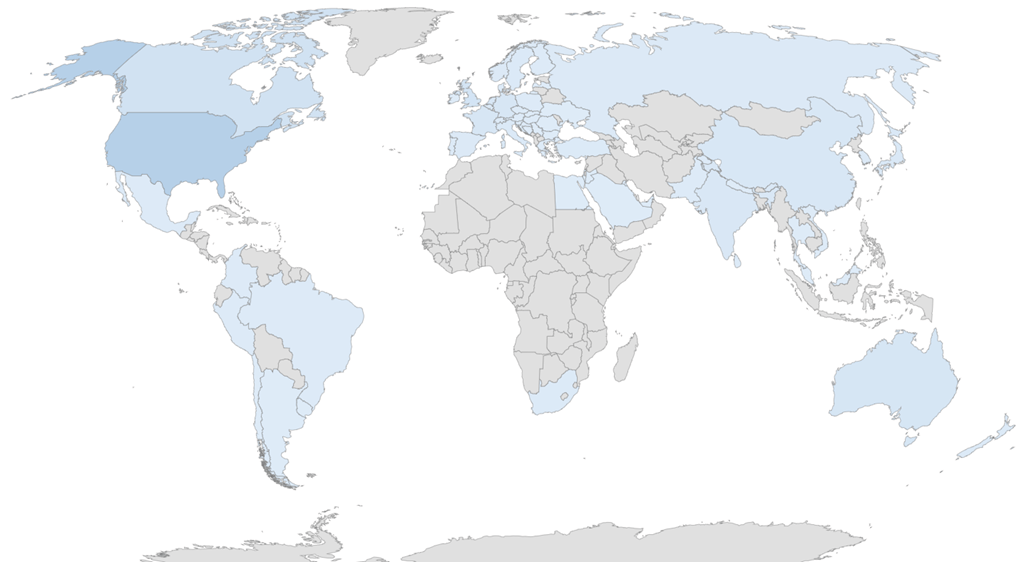
When zooming in on the Office Servers and Services MVP’s category, the awards per country is shown in the following heath map and table. Be advised that MVP’s that are anonymous or have profiles without location (~23 for Office Servers and Services), are not taken into account since their location is unknown.

image

Country Number Country Number Country Number
Argentina 0 (-100%) Ireland 1 (0%) Saudi Arabia 1 (0%)
Australia 17 (-40%) Israel 0 (-100%) Serbia 1 (0%)
Austria 2 (0%) Italy 8 (-20%) Singapore 3 (-25%)
Belgium 8 (0%) Japan 11 (-45%) Slovakia 1 (0%)
Bosnia-Herzegovina 2 (0%) Jordan 1 (0%) Slovenia 1 (-50%)
Brazil 2 (-34%) Korea 6 (-15%) South Africa 4 (-20%)
Bulgaria 1 (0%) Latvia 1 (0%) Spain 5 (-17%)
Canada 29 (-24%) Macedonia F.Y.R.O 2 (0%) Sri Lanka 4 (-43%)
Chile 1 (0%) Malaysia 1 (-50%) Sweden 6 (-25%)
China 14 (-13%) Mexico 2 (-50%) Switzerland 5 (0%)
Colombia 2 (0%) Nepal 1 (0%) Thailand 1 (0%)
Croatia 5 (-17%) New Zealand 4 (-20%) The Netherlands 13 (-8%)
Czech Republic 3 (-25%) Norway 5 (-17%) Turkey 4 (-20%)
Denmark 2 (-50%) Pakistan 2 (0%) Ukraine 1 (-50%)
Egypt 1 (-50%) Peru 1 (-50%) United Arab Emirates 1 (-50%)
Finland 2 (0%) Poland 2 (0%) United Kingdom 23 (-15%)
France 15 (-12%) Portugal 3 (-25%) United States 90 (-19%)
Germany 16 (-20%) Romania 1 (-50%) Uruguay 1 (0%)
Greece 1 (0%) Russia 5 (-50%) Vietnam 0 (-100%)
Hungary 2 (-50%) TOTAL 383 (-22%)
India 12 (-8%)

As shown, some countries have lost their Office Servers and Service MVP’s completely. Looking at the total number of Office Servers and Services MVP’s over the year, the number went a little up again due to monthly awardees, but with the July cycle, the number of Office Servers and Services MVP’s went from 490 to 383 (-22%).

The number of Office Servers and Services and total number of MVP’s over the last years (since award restructuring).

Month oct2016 jan2017 jun2017 jul2017 jan2018 jun2018 jul2018
OSS 538 505 (-7%) 532 (+5%) 449 (-16%) 480 (+6%) 490 (+2%) 383 (-21%)
Total N/A N/A 4134 3490 (-16%) 3747 (+7%) 3815 (+2%) 3030  (-21%)

Unfortunately, I have no data on the other categories from before june 2017.

If you have questions or comments, please discuss in the comments.

2018-2019 Microsoft MVP Award

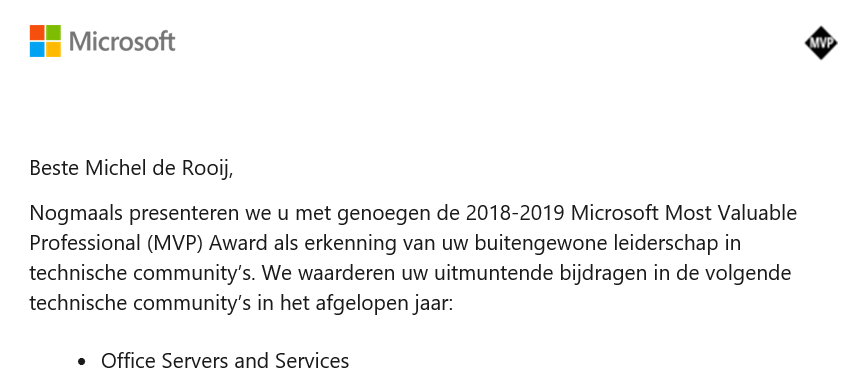
With great joy and honor I can announce that I have been awarded the Microsoft Most Valuable Professional Award in the category Office Servers and Services (localized e-mail):

image

MVP awards are given to individuals by Microsoft in recognition of their contributions to the community, such as:

  • Writing blogs, articles, books.
  • Speaking engagements or podcasts.
  • Supporting others, e.g. forum or TechCommunity contributions.
  • Code contributions.
  • Product feedback.

This is my 5th consecutive year as an MVP. I used to be an “October MVP”, which meant my award was up in October every year. After the award cycle changed to a yearly one for everyone, this year was the first time all MVP’s who fell under the old quarterly cycles, were being up for renewal. It also meant, contributions of a longer period of time were being evaluated. So lots of kudos to the MVP leads and other folks that had to go through the monstrous task of reviewing thousands of contributions for this cycle.

Many thanks to the community, readers, followers, fellow MVP’s and friends, peers, product groups and other Microsoft employees for their encouragement, inspiration and support over all those years.

My MVP profile can be found here.