Review: Microsoft Exchange 2013 Cookbook


The folks at PacktPub asked me to review a book written by Exchange fellow Michael van Hoorenbeeck and Peter de Tender, titled “Microsoft Exchange 2013 Cookbook”. So, here goes.

The books is well structured, starting off with planning and designing your Exchange 2013 deployment on to installing the product. It then turns to configuring the individual Client Access Server and Mailbox Server role specifics, like certificates or Database Availability Groups. Next up is configuring external access which is described vendor neutral. Special attention is then paid to individual features like High Availability, backup/recovery, compliance and security. The book ends with Van Hoorenbeeck’s favorite subject, hybrid deployments. That chapter is unfortunately a bit short, but I’m inclined to think this is intentional and may be because an Office 365 book with information on this subject may be in the works.

The 326 page book is easy to read (I read it on the flight from Amsterdam to Bangkok). What is nice is that the book prefers to describe procedures using PowerShell cmdlets (recipes) instead of showing the GUI method, which is not only good for the adoption of PowerShell but also building PowerShell skills for some admins. Well-known tools of the trade are being mentioned in the book, like the infamous Exchange 2013 Server Role Requirements Calculator or Exchange fellow Paul Cunningham’s Get-DAGHealth.ps1 script for checking and reporting DAG health status. Yours truly also gets mentioned for the Exchange 2013 Unattended Installation Script; I won’t complain about misspelling my name though.

I haven’t had the chance to check out the Exchange Inside Out bible(s) by Tony Redmond and Paul Robichaux yet, but this book could be of value for admins trying to get up to speed with Exchange 2013, building PowerShell knowledge through PowerShell-by-example by reading this book and its practical task accomplishing instructions.

You can check for the book on Amazon here.

The UC Architects Podcast Ep29


iTunes-Podcast-logo[1]We’re glad to announce the availability of episode 29 of The UC Architects podcast.

This episode is hosted by Pat Richard, who’s joined by John Cook, Serkan Varoglu, Dave Stork and Tom Arbuthnot. Special guest is Iain Smith.

Topic of this episode are:

  • Microsoft buys Nokia
  • New MVPs / MCSMs
  • Lync 2013 Call Pickup Group Manager
  • Lync Server 2013 Certificate Authentication and Passive Authentication Support for Lync 2013 Mobile Applications
  • Update that enables the “operator assistance” feature during a PSTN dial-in conference in a Lync Server 2013 environment
  • Microsoft Lync Deployment Checklist
  • Lync 2013 Support Added to System Center Advisor
  • Visualize Lync usage for your business with new reports
  • AOL Announces Direct Federation With Microsoft Lync and UC Federation Plans for AIM
  • Microsoft Lync Room System Administrative Web Portal
  • Department of Defense employees now able to use Microsoft Lync 2013 to connect to information network
  • Lync 2013 Client September 2013 CU Released: New Spell Check, Tray Icon Back
  • Lync 2013 CU October 2013 (support for Windows Server 2012 R2; breaks font in LSCP)
  • October 2013 CU for LPE devices (transfer to voicemail option)
  • Microsoft Lync Server 2013 Protocol Workloads Poster
  • Review of headsets
  • Announcing the Release of the Lync Server Networking Guide v2
  • Office 365 Mail Flow Troubleshooter
  • How to Block OWA 2010 and 2013 for External Users
  • Exchange Server Deployment Assistant

More information on the podcast including references and a link to download the podcast here or you can subscribe to the podcasts using iTunes, Zune or use the RSS feed.

About
The UC Architects is a bi-weekly community podcast by people with a passion for Unified Communications; our main focus is on Exchange, Lync or related subjects.

Slow Mailbox (Migration) Throughput and HP NIC Drivers


Hewlett-Packard_logo-web[1]A small post on an issue I recently encountered when doing preparations for a mailbox migration. The system was an HP Proliant DL370 G6 system, prepared and configured with the OS and Exchange by the customer’s IT department.

Things looked OK and we were going to perform some test migrations to get an throughput estimation for this configuration  to help us organize migration batches. To our dismay, speeds were way lower than we were used to see with similar configurations; mailboxes were migrated with an average speed of 7-8 MB/min, where we used to see something in the 50-120 range.

A quick look on the performance monitor didn’t show anything out of the ordinary, except for very low downstream network throughput. With the servers (the original Exchange server as well as the new one) being on the same subnet and physically next to each other, networking components were also not deemed suspect (other servers on same switch were not experiencing this issue).

I then tried something simple: copying near 100 MB of files from the source Exchange server to the new one. It went at an ridiculous slow speed of 60-80 KB/s. Copying those same files from the new server to the source server was instantly. I verified this against a vacant server on the same switch; copying from and to the source Exchange server on that server was instant, both up- and downstream.

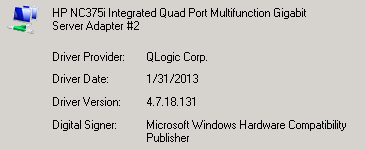
So, if SMB was having trouble getting packets across, that could explain the slow mailbox migration speeds. Attention shifted to the networking configuration on the new Exchange server, which was equipped with a HP NC375i Integrated Quad Port Multifunction Gigabit Server Adapter. I checked the driver version of one of the NC375i’s instances through Network Connections > Properties (of instance) > Configure > Driver (tab). It reported QLogic Corp. driver 4.7.17.926 (qlxgnd64.sys) was used.

After some searching on HP’s support site I discovered an advisory which could apply to my situation as it applies to the same qlxgnd64.sys driver version 4.7.17.926: c03734205, “Advisory: HP NC Network Adapters – Certain HP NC-Series Network Adapters May Experience Very Slow Bandwidth During Large File Transfers on Windows Server 2008 and Windows Server 2008 R2”.

The advisory gives the option to either keep the driver and disabling Large Receive Offload (LRO) or to upgrade to driver version 4.7.18.131. We choose the latter:

image

After upgrading the driver, we moved a mailbox and and throughput speeds were within the expected range again as we found out when producing a quick stats report using the cmdlet (Exchange 2010):

Get-MoveRequest | Where { $_.Status -eq "Completed" } | Get-MoveRequestStatistics | Select DisplayName,TotalMailboxSize,TotalMailboxItemCount,@{n="Speed MB/min"; e={ [int]($_.BytesTransferred.ToMB() / $_.TotalInProgressDuration.TotalMinutes) }}

image

In my opinion, it’s another fine example of the value of testing and validating your configuration and any amendments you make before putting them in production and be cautious with what I call “blindly updating” of system components such as drivers or driver packs (e.g. HP’s SPP or Service Pack for ProLiant).

If you don’t have the luxury of a test- and acceptance environment, just as with Service Packs, Rollups and Cumulative Updates, have a waiting period and check the vendor’s support site for any reported issues before implementing updates yourself; according to this discussion on the HP support forum, the issue with the 4.7.17.926 QLogic driver existed for quite some time.

The UC Architects Podcast Ep28


iTunes-Podcast-logo[1]We’re glad to announce the availability of episode 28 of The UC Architects podcast. This is a special episode recorded with a live audience during DevConnections 2013 in Las Vegas.

This episode is hosted by Steve Goodman, Johan Veldhuis, and Michael van Horenbeeck. Special guests are Tony Redmond, Greg Taylor (Microsoft), Jeff Mealiffe (Microsoft) and John Rodriguez (Microsoft).

Topics discussed in this special episode are:

  • MEC is back  – registration is now open, so get signing up! What might await those thinking of going? And with MEC, is there still a gap in the market for conferences like Exchange Connections?
  • Where is the place for on-premises Exchange long-term and how does this affect the Exchange-centric IT pro? What kind of skills will they need in 2-5 years time?
  • Is there a need for top level training and certification for Exchange?
  • Product quality – Is is Exchange a victim of it’s own success?
  • Exchange in the public cloud. Amazon Web Services have released a guide on deploying Exchange on AWS. Does this give more choice to organizations?
  • Questions from the audience

More information on the podcast including references and option to play or download the podcast directly through here or you can subscribe to the podcasts using iTunes, Zune or use the RSS feed.

About
The UC Architects is a bi-weekly community podcast by people with a passion for Unified Communications; our main focus is on Exchange, Lync or related subjects.

2013 Microsoft MVP Award


I am pleased to announce that as of today, I am the recipient of the 2013 Microsoft MVP Award for Exchange Server:

image

MVP awards are given to individuals by Microsoft in recognition of their contributions to the technical community, such as this blog, forums or our very own The UC Architects podcast.

I’d like to take this opportunity to thank my readers, followers, fellow MVPs (always wanted to say that) and of course the Microsoft employees that have encouraged, helped and supported me over years.

My MVP profile can be found here.