iOS 9.3 fixes Multiple Response issue


iPhone 6 iOSUpdate 5/31/16: The glitch has been addressed in iOS 9.3.1.

Note: Be advised that iOS 9.3 contains a glitch which might prevent users from opening links from applications like Safari or other browsers, Mail or Outlook. The glitch causes the link not to work or the app to hang. Apple is aware of the issue and a fix is in the works. It is reported that, as a temporary workaround, disabling Javascript support in Settings > Safari > Advanced makes links work again in Safari.

Apple released iOS 9.3 today, which contains lots of enhancements and fixes. One of these fixes solves an issue with the Calendar app (for those still not using the Outlook app), where it would send multiple responses for an invite.

The release notes of iOS 9.3 mention:

Resolves an issue for some Exchange users that caused Calendar to send multiple responses to the same invitation

The fix supposedly solves issue 1.15 from the “Current issues with Exchange ActiveSync and 3rd-party device” overview (KB2563324), “Meeting organizer receives multiple responses from attendee. The related KB article, KB3108212, also contains instructions on how to identify users experiencing this problem. Note that the problem has also been addressed server-side in Cumulative Update 1 for Exchange 2016.

It’s almost a law that, for every bug that is fixed, new ones are introduced. So, some organizations may therefor want to test and accept this iOS update before giving it the green light for their Exchange environment. To block a specific version of iOS from Exchange, consult the instructions here.

Outlook for iOS adds Contacts support


imageA short notice on an update received today for Outlook for iOS 2.09. This update adds the much requested feature of integrating Outlook for iOS with the (native) Contacts in iOS:

“Your Office 365 and Exchange Contacts can now be saved to the iOS Contacts app. This will allow you to easily see the name of a contact when you receive a call or text message from them. Head to your Advanced Settings to turn on this feature.”

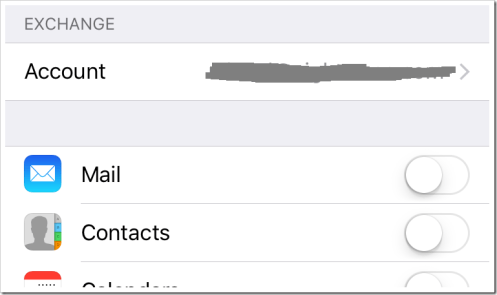
This does away with the requirement of resorting to setups like having the iOS Mail app sync with your Office 365 or Exchange On-Premises account, just to sync those contacts with your device. To disable syncing contacts through the Mail app, go to Settings > Mail, Contacts, Calendars and click the account you wish to disable syncing contacts for. Then, disable syncing its Contacts by toggling its switch:

image_thumb.png

You will get a warning contacts synced through this contact will be removed from Contacts, but since we are going to use Outlook for this, you can proceed.

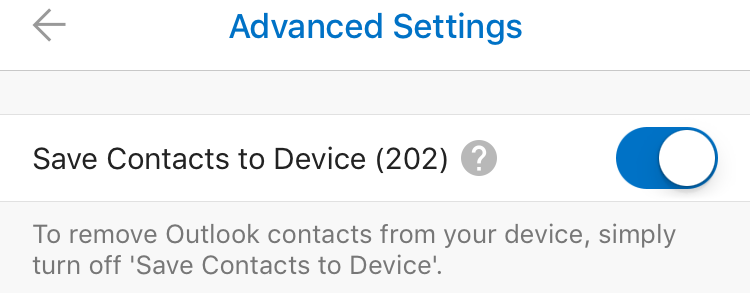
Next, open up the updated new Outlook app, and go to Settings. Click the account from which you want to sync contacts to your device, and select Advanced Settings. In there, you will find a new switch, Save Contacts to Device. Behind it is the number of contacts available on this account:

image

Toggle the switch to start syncing contacts directly from your Office 365 or Exchange On-Premises account to Contacts, giving the Outlook app permissions to access your Contacts when requested. After this, you’re ready to go.

Note that all synced contacts will contain a line in the Notes field, stating:

Exported from Microsoft Outlook (Do not delete) [outlook:..:..]

This is to indicate this is a synced contact, and you must not edit or remove it using the device, rather remove it from the originating source as it might get recreated or overwritten during synchronization.

Finally, the sync is one-way, so although you can edit properties on your phone through the Contacts app, they won’t be synced back to the originating source. Also, when editing properties through Contacts, those edits are not propagated to the People view in the Outlook app, as those are the contacts from your Office 365 / Exchange On-Premises accounts. This can be confusing, but having to set up an e-mail account just once with a one-way sync seems more efficient and less confusing to me than having to configure the Mail app only to get your contacts on your phone.

Blocking Outlook App for iOS & Android


imageYesterday, Microsoft announced the immediate availability the Outlook for iOS and Outlook for Android preview. These apps are the former app named Acompli, which was acquired by Microsoft in December, last year. It is unlikely that Microsoft will develop and support two similar apps, so one can assume the new Outlook app will replace the current OWA for iOS and OWA for Android (or just OWA for Devices) apps.

The app isn’t without a little controversy:

  • The app stores credentials in a cloud environment from Amazon Web Services for e-mail accounts that don’t support OAuth authorization.
  • The app makes use of a service sitting between the app and your mailbox. This service acts as a sort of proxy (hence it requires those credentials), fetching, (pre)processing and sending e-mail. In some way this is smart, as it makes the app less dependent on back-end peculiarities, using a uniform protocol to communicate with the proxy service.
  • The app does not distinguish between devices (device identities are assigned to your account, which makes sense since the app uses a service to retrieve and process your e-mail).
  • The app does not honor ActiveSync policies, like PIN requirements. While true, this app is not an ordinary Exchange ActiveSync client.

You can read more about this here and here.

In all fairness, when the app was still named Accompli, nobody cried foul. But the app is now rebranded Outlook and property of Microsoft, so it seems this made the app fair game. I hope Microsoft is working behind the scenes to make the new Outlook app enterprise-ready, and I’m sure it won’t be long before we see the app’s services move from AWS to Azure. The whole outrage in the media also seems a bit misplaced, as Connected Accounts in Exchange Online, which will retrieve e-mail from a POP or IMAP mailbox, will also store credentials ‘in the cloud’.

It is recommended to treat the app as a consumer app for now, and you may want to block the app in your organization. I have written on how to accomplish blocking or quarantining faulty iOS updates before. However, in those articles I used the reported OS version to block or quarantine devices. The Outlook app proxy service reports itself as “Outlook for iOS and Android” as device model when querying your mailbox, allowing us to use the DeviceModel parameter for matching.

The cmdlet to block or quarantine the new Outlook app in Exchange 2010, Exchange 2013 or Office 365,  is:

New-ActiveSyncDeviceAccessRule –QueryString 'Outlook for iOS and Android' –Characteristic DeviceModel –AccessLevel Block

or, to quarantine:

New-ActiveSyncDeviceAccessRule –QueryString 'Outlook for iOS and Android' –Characteristic DeviceModel –AccessLevel Quarantine

For examples of alternative blocking methods using TMG or F5, check this article. If you need to specify the user agent string, use “Outlook-iOS-Android/1.0” (or partial matching on “Outlook-iOS-Android” to block future updates of the app as well).

As goes for all mobile devices in enterprise environments, as an organization it may be better to test and aprove devices and OS versions rather than to be confronted with mobile apps with possible faulty behavior after an update or which may violate corporate security policies.

OWA for iPhone and OWA for iPad are here!


imageToday, the Exchange team announced the immediate availability of the (free) OWA for iPhone and OWA for iPad apps. Exchange fellows Tony Redmond and Dave Stork already hinted earlier this month that something was about to happen in this area.

Users of the Windows 8 Mail app may find the look of the OWA apps to be very familiar:

A quick summary on the app features:

  • Stored credentials for automatic logins;
  • Push notifications;
  • Meeting reminders (even with app closed);
  • Voice activated actions (English only);
  • Contact sync for caller ID function;
  • Remote wipe capability (user data, when the app runs).

That last one is a great, much requested feature when Bring Your Own Device is practiced (apart from that it makes sense due to the sandboxing principle). When required the business can selectively wipe business data without touching your personal information, similar to a feature to be introduced with Windows 8.1 called Remote Business Data Removal.

Besides that you need an iPhone 4S or iPad 2 or higher running iOS 6 or later, the apps are currently only supported for Office 365 subscribers running the tenant on Wave15 (or later). There are reports of the apps working with on-premises Exchange 2013 but that’s unofficial. To find out which version your tenant is running, use Get-OrganizationConfig in a remote PowerShell session, e.g.

$session = New-PSSession –ConnectionUri https://ps.outlook.com/powershell –AllowRedirection –Authentication Basic –Credential (Get-Credential) –ConfigurationName Microsoft.Exchange
Import-PSSession $session
Get-OrganizationConfig | ft AdminDisplayVersion

image

My tenant is running on 15.0.698.10 (15 = Wave 15), so theoretically I’m good to be running OWA for iPhone or OWA for iPad. I say theoretically, as I don’t have any iPhone or iPad available for testing.

An app version for on-premises Exchange 2013 is expected to be released at a later date. More information on configuration and usage of the OWA apps on the Office 365 blog here.

The UC Architects Windows Phone App


Most of you listen to or at least are aware of our The UC Architects podcast. If not, The UC Architects is the world’s most popular community podcast on Exchange and Lync made by people with a passion for Microsoft Unified Communications.

CaptureNow, as of today and thanks to fellow Johan Veldhuis, you can keep track of new podcasts when travelling, check our Tweets or even download and listen to podcasts using the UC Architects Windows Phone App. The app is available for Windows Phone 7 and 8. More information on the app itself can be found on our The UC Architects website.

You can download the app here.