Exchange 2007 SP3 Update Rollup 4


Today the Exchange Team released Rollup 4 for Exchange Server 2007 Service Pack 3 (KB2509911). This update raises Exchange 2007 version number to 8.3.192.1.

Here’s the big list of changes included in this rollup:

  • 2531208  You cannot synchronize a folder hierarchy by using Outlook for Mac 2011 in an Exchange Server 2007 SP3 environment
  • 2528437  EWS applications cannot connect to Exchange Server 2007 servers after you make changes on accepted domains
  • 2521063  You are incorrectly displayed as a meeting organizer after you synchronize the meeting by using your mobile device in an Exchange Server 2007 environment
  • 2517337  You cannot open a mailbox that has a “#” character in the primary SMTP email address by using OWA in an Exchange Server 2007 environment
  • 2515428  The MSExchangeMailboxAssistants.exe process crashes when the managed folder assistant tries to journal a message in an Exchange Server 2007 environment
  • 2508872  The W3WP.exe process in the Autodiscover application pool on the Exchange Server 2007 Client Access servers consumes excessive CPU resources
  • 2507374  “Cannot open this item” error message in Outlook online mode in an Exchange Server 2007 environment
  • 2506827  An UM auto attendant times out and generates an invalid extension number error message in an Exchange Server 2007 environment
  • 2502276  A meeting request series are deleted unexpectedly from the calendar in an Exchange Server 2007 environment
  • 2498924  “Could not connect to a directory server” error message when you click the last page button in the search results in Exchange Server 2007 OWA
  • 2498156  OLM/OLD incorrectly runs against databases in a RSG in an Exchange Server 2007 environment
  • 2496806  A mobile phone times out when you use ActiveSync to synchronize the calendar on the mobile phone with an Exchange Server 2007 mailbox
  • 2543879  A PDF attachment sent from a Mac Mail client does not display when you open the email message by using Outlook 2010 in an Exchange Server 2007 SP3 environment
  • 2491751  Spell checking does not function correctly in OWA when an S/MIME control is used and SSL Offloading is enabled in Exchange Server 2007
  • 2484147  “HTTP Error 400 Bad Request” error message when you use OWA to log on to a newly created Exchange Server 2007 mailbox
  • 2466220  Question mark (?) characters appear in the subject of a reply email message in an Exchange Server 2007 environment
  • 2223294  A new feature is available to disable the “No end date” check box in OWA when you create a recurring meeting item in an Exchange Server 2007 environment
  • 977906  You receive an error message when you run certain commands in the EMS on an Exchange Server 2007 server
  • 2495010  The EdgeTransport.exe process consumes 100% CPU usage on an Exchange Server 2010 Edge Transport server or an Exchange Server 2007 Edge Transport server
  • 2484817  A mailbox does not show in certain address lists after you run commands on an Exchange Server 2007 mailbox

When running ForeFront Protection for Exchange, make sure you disable ForeFront before installing the rollup and re-enable it afterwards, otherwise the Information Store and Transport services may not start. You can disable ForeFront using fscutility /disable and enable it using the fscutility /enable command.

Note that update rollups are cumulative, i.e. they contain fixes released in earlier update rollups for the same product level (RTM, SPx). This means you don’t need to install previous update rollups during a fresh installation but can start with the latest rollup available right away.

You can download Exchange 2007 SP3 Rollup 4 here.

Exchange 2010 SP1 Update Rollup 4 Issues


Be advised that in addition to earlier reports, there are not only data loss issues with Exchange 2010 SP1 Rollup 4 when moving folder structures from public folders to mailboxes or other public folders.  Apparantly, data loss can also occur when moving folder structures to PST files. In both cases, only the top folder and messages are moved, subfolders and their contents are not moved but deleted.

On the issue, Microsoft’s Ross Smith said the following:

In SP1 RU4 we addressed the issue where you could not recover deleted public folders from dumpster. However, Outlook incorrectly passes a flag that indicates the item has been deleted when it has not.  As a result, when you perform a copy or move in the manner Jens described, the sub-folders are deleted.  As mentioned previously, you can recover these deleted folders from dumpster.  We’ve contacted the Outlook team to assist in further diagnosis of the issue and to help us determine the right vehicle for a fix, we’ll provide more details soon – in the meantime please open a CSS case.

You can uninstall Rollup 4 from your Exchange servers to prevent potential data loss caused by these issues.

Note that Rollup 5 is scheduled for August, so you might start to wonder what will arrive first, RU5 or RU4v2.

Exchange 2010 SP1 Update Rollup 4


Update June, 29th: Reports of issues with PF after installing RU4 here (comments section). Exchange fellow Paul Cunningham reproduced a PF issue which can lead to data loss. More about this on his blog here. Once again I emphasize to properly test updates prior to implementing in production. Although I’m aware of possible budget constraints, not having a proper test environment in fact means you have no production environment.

Today the Exchange Team released Rollup 4 for Exchange Server 2010 Service Pack 1 (KB2509910). This update raises Exchange 2010 version number to 14.1.323.1.

After the rollup 3 debacle, I’d recommend to thoroughly test rollup 4 in a test and acceptance environment prior to implementing it in production.

Here’s the big list of changes included in this rollup:

  • 2537099  “80040154” error message when you try to configure external Client Access namespaces on an Exchange Server 2010 server
  • 2536700  Outlook stops responding when you try to copy a folder to its subfolder by using Outlook in online mode in an Exchange Server 2010 SP1 environment
  • 2536517  The Microsoft Exchange RPC Client Access service crashes intermittently on an Exchange Server 2010 server
  • 2536494  It takes a long time to return results when you perform an Advanced Find search on a mailbox by using Outlook in online mode in an Exchange Server 2010 SP1 environment
  • 2535648  The EMC takes a long time to open in an Exchange Server 2010 environment
  • 2535130  Performance in Outlook or in OWA decreases when you use IMAP4 to access the contacts folder in an Exchange Server 2010 environment
  • 2535105  There is no option to disable the Availability service in an Exchange Server 2010 environment
  • 2533543  Event ID 2153 is logged on each database availability group member in an Exchange Server 2010 environment
  • 2533538  You cannot look up the free/busy information of a user who is located on an Exchange Server 2010 organization from another Exchange Server 2010 organization
  • 2533451  A RBAC role assignee can unexpectedly run the “Update-FileDistributionService” command on an Exchange Server 2010 server that is outside the role assignment scope
  • 2519359  “Changes to the rule cannot be saved.” error message when you try to create a reply rule by using Outlook in an Exchange Server 2010 environment
  • 2518850  You cannot receive email messages on a mobile phone by using ActiveSync in an Exchange Server 2010 environment
  • 2517088  Public folder conflict resolution does not work as usual in an Exchange Server 2010 environment
  • 2515259  “The items could not be copied.” error message when you run the Get-MailboxSearch cmdlet in an Exchange Server 2010 SP1 environment
  • 2514709  Event ID 1001 after you successfully the install Exchange Server 2010 Unified Messaging server role
  • 2514574  The Exchange RPC Client Access service crashes in an Exchange Server 2010 environment
  • 2513723  The “New-MailboxImportRequest” cmdlet does not import all messages in a .pst file in the ANSI format in an Exchange Server 2010 environment
  • 2512023  “GetUserOofSettings”, “SetUserOofSettings” and “GetUserAvailability” operations do not support Exchange Impersonation on the Exchange Server 2010 SP1 schema
  • 2511897  You cannot send an email message to a mailbox for a brief period when you move the mailbox by using online move in an Exchange Server 2010 environment
  • 2507463  You cannot move a mailbox that contains a corrupted Search Folder in an Exchange Server 2010 environment
  • 2506820  The free/busy information does not display of a user whose mailbox is located on an Exchange Server 2003 server
  • 2506049  The hierarchy of a new public folder database on an Exchange Server 2010 SP1 server is not replicated
  • 2505968  The EdgeTransport.exe process crashes when you apply a rule that contains a bad email address in an Exchange Server 2010 environment
  • 2504453  You cannot retrieve statistical information about a public folder by using the “Get-PublicFolderStatistics” cmdlet in an Exchange Server 2010 SP1 environment
  • 2503337  Comments of your meeting response message is missing when you decline a meeting request in an Exchange Server 2010 environment
  • 2501070  A RBAC role assignee can stop queue processing on an Exchange Server 2010 Hub Transport server or an Exchange Server 2010 Edge Transport server that is outside the role assignment scope
  • 2500903  A space is missing in the subject line of a “Tentative” meeting response in an Exchange Server 2010 environment
  • 2500648  “There are no items to show in this view.” error message when you try to view a folder in Outlook in an Exchange Server 2010 environment
  • 2495167  You cannot recover a deleted public folder by using Outlook or MFCMAPI in an Exchange Server 2010 environment
  • 2495010  The EdgeTransport.exe process consumes 100% CPU usage on an Exchange Server 2010 Edge Transport server or an Exchange Server 2007 Edge Transport server
  • 2493393  You cannot use ECP to perform a wipe on a mobile phone in an Exchange Server 2010 SP1 environment
  • 2492068  “The item cannot be saved to this folder.” error message when try to post an item to a mail-disabled public folder in an Exchange Server 2010 SP1 environment
  • 2491354  You cannot view the free/busy information of users in a mixed Exchange Server 2007 and Exchange Server 2010 environment
  • 2490134  A deferred delivery email message is not delivered by using Outlook 2007 in online mode in an Exchange Server 2010 environment
  • 2489964  An update enables range 0x-0x1F characters in the display name of an Exchange Server 2010 user account
  • 2489938  The “Connect-ExchangeServer” function does not change the target Exchange server in Exchange Server 2010
  • 2489130  A RBAC role assignee can unexpectedly change mailbox properties that are outside the management role group scope in an Exchange Server 2010 environment
  • 2488643  Outlook downloads duplicated POP3 email messages in an Exchange Server 2010 environment
  • 2479188  The iCal parts of an email message contain invalid entries when they are sent from an Exchange Server 2003 mailbox to an Exchange Server 2010 mailbox
  • 2477273  The DomainController parameter does not work when you use the “MoveMailbox.ps1” script to move mailboxes in an Exchange Server 2010 environment
  • 2471964  A NDR is sent to the sender when you move an email message to a personal folder file in an Exchange Server 2010 SP1 or a later version environment
  • 2467619  A user who manages a distribution group cannot remove another user whose mailbox is disabled in an Exchange Server 2010 environment
  • 2465292  “MAPI_E_FAILONEPROVIDER (0x8004011D)” error message when you access an Exchange Server 2010 mailbox by using a MAPI application
  • 2446908  ESE event descriptions are missing in Event Viewer when the Eseutil utility is called on an Exchange Server 2010 SP1 server
  • 2394554  An email message is not delivered if it contains unsupported encoded characters in the subject line in an Exchange Server 2010 environment
  • 2491951  You cannot install Exchange Server 2010 SP1 if the NetBIOS domain name of the domain controller contains an ampersand (&) character
  • 2507066  Administrator audit logging is disabled unexpectedly during an Exchange Server 2010 SP1 installation

When running ForeFront Protection for Exchange, make sure you disable ForeFront before installing the rollup and re-enable it afterwards, otherwise the Information Store and Transport services may not start. You can disable ForeFront using fscutility /disable and enable it using the fscutility /enable command.

For the correct procedure on how to update a DAG and its members, check here.

Note that update rollups are cumulative, i.e. they contain fixes released in earlier update rollups for the same product level (RTM, SPx). This means you don’t need to install previous update rollups during a fresh installation but can start with the latest rollup available right away.

You can download Exchange 2010 SP1 Rollup 4 here.

Forefront Protection for Exchange Rollup 3


Microsoft released Hotfix Rollup 3 for Forefront Protection for Exchange Server (KB2538719).

Here’s the list of fixes included in this rollup:

  1. Mail queues and sluggish Exchange/Outlook performance
  2. Increased “Available Disk Space” Health Point threshold to 250MB
  3. Error: The DNS Blocklist lookup domain blocklist.messaging.microsoft.com could not be contacted
  4. The Exchange Information store crashes with Forefront Protection for Exchange installed
  5. An attempted upgrade of Forefront Protection for Exchange fails with a “Registration Service Failed” error
  6. You receive Forefront Protection Health Notifications indicating a status of “Green to Green”
  7. Forefront generates a MaxDisabledWait error within 15 minutes after starting
  8. A MaxDisabledWait error occurs and Forefront Protection does not recover
  9. Forefront Protection doesn’t apply keyword filtering within hyperlink strings
  10. Forefront Protection for Exchange crashes while scanning a TAR file
  11. An engine update fails in Forefront Protection for Exchange
  12. Emails that are 90 MB or larger are being sent to the Forefront archive folder
  13. The Microsoft Forefront Server Protection Eventing Service will not start following an upgrade from a beta version of Forefront Protection for Exchange
  14. Forefront Protection for Exchange detects files as “Engine Error” when no engines have been enabled for scanning
  15. Messages quarantined due to engine error can now be delivered as complete email
  16. High CPU conditions in EdgeTransort.exe process result in crash
  17. You receive Forefront generated email notification that the Cloudmark engine or Worm list could not update
  18. Exchange email queues at startup following an abnormal shutdown

For more details on the fixes consult the related knowledge base article. You can request the hotfix rollup through the support center here.

Updating Exchange 2010 DAG Members


With all the (re-)releases of rollups, the question might rise on how to perform a proper up or downgrade of all DAG configuration members.

Basically, the procedure is straightforward and should be followed per DAG member:

  1. Appoint (next) DAG member;
  2. Move away all active copies on that DAG member;
  3. Prevent copies from activating on that DAG member;
  4. Perform maintenance, e.g. down or upgrade DAG member;
  5. Enable possible activation on that DAG member again;
  6. Optionally redistribute database copies.

Note that in a DAG configuration with 2 members, you need to be aware that during maintenance you have a temporary situation with no fail-over options. If that’s undesirable, consider implementing a 3rd DAG member.

To make the above procedure  easier and automated regarding moves and activation (un)blocking, additional scripts are available since SP1 for Exchange 2010. These scripts are located in the Scripts folder, below the Exchange installation folder. By default the location of the scripts will be C:\Program Files\Microsoft\Exchange Server\v14\Scripts.

Utilizing them, the procedure is quite easy as you can see below. Note that the example uses a DAG named DAG1 with nodes ex2010a and ex2010b as members. They both host 2 databases, ex2010mdb1 and ex2010mdb2; both host 1 active copy and a passive copy of the other database.

  1. Appoint (next) DAG member, e.g. ex2010a;
  2. Run StartDagServerMaintenance.ps1 targeting that DAG member, e.g.:
    .\StartDagServerMaintenance.ps1 –server ex2010a

    image
  3. Perform maintenance;
  4. Run StopDagServerMaintenance.ps1 targeting that DAG member, e.g.:
    .\StopDagServerMaintenance.ps1 –server ex2010a
  5. Repeat steps 2-3 for the other DAG member(s):image
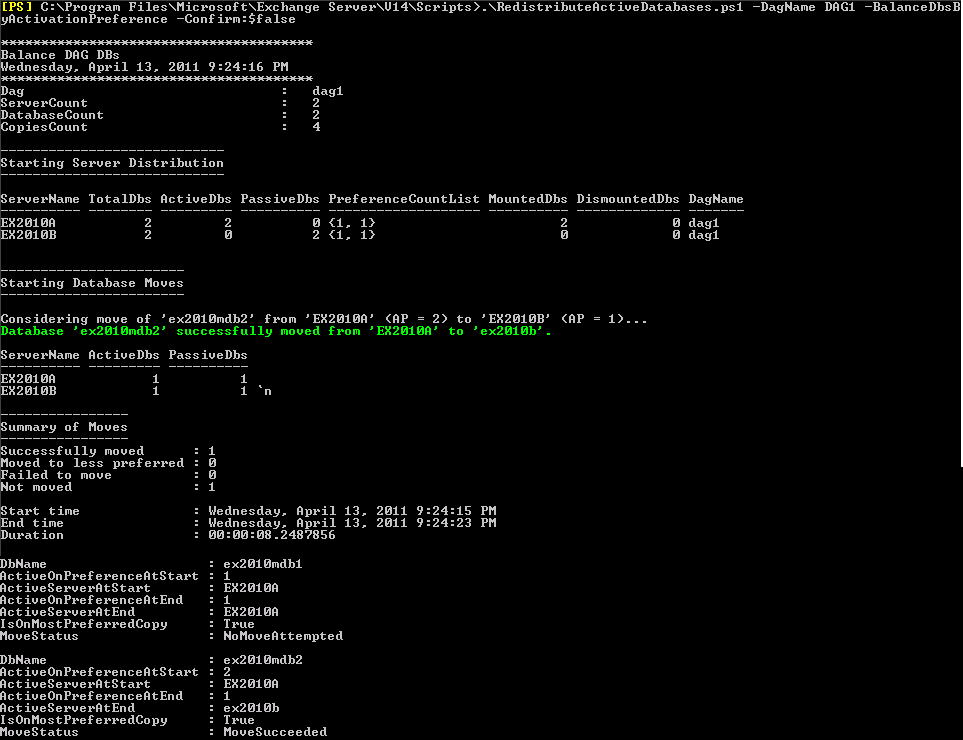
  6. Optionally run RedistributeActiveDatabases.ps1 for the DAG, e.g.:
    .\RedistributeActiveDatabases.ps1 –DagName DAG1 –BalanceDBsByActivationPreference –Confirm:$false

    image

Be advised that when upgrading on major levels (RTM to SP1 or SP1 to SP2), you can’t move a database to a lower level host. This means that when upgrading a node from SP1 to SP2 and moving a database to that SP2 node in the process, you can’t move that database to any SP1 nodes in the DAG. Keep this in mind when planning your upgrade, because it will impact the availability level by limiting your fallback options, albeit temporarily.