More Geek out with Perry


Few days ago, Perry Clark, general manager Exchange, posted another video on Exchange design decisions. Subject this time is the apparantly much asked customer question on why recent Exchange versions require rolling moves or migrations instead of in place upgrades?

For previous Geek out with Perry videos, check out this earlier post.

Exchange Processor Query Tool


For aiding people in sizing their Exchange 2010 mailbox server configuration you can use the Mailbox Role Calculator. As of version 12.3 you can use the Intel SPECint2006 rate value to make calculations regarding the CPU. Unfortunately, not everyone owns a specific configuration shown on the SPECint2006 list.

The Exchange Product Group has come up with a tool (XLS) that calculates the average rate value for a specific CPU, using online SPECint information of configurations with the same CPU. Although not exact, it should provide you with guidance on the megacycles per core value to use in the Mailbox Role Calculator.

You can download the Exchange Processor Query Tool here.

Exchange Toolkit


I did a write up on the Exchange toolkit, you can find it here or access it through the menu.

If you got feedback, want to report inaccuracies or think something must be added to the list, please send me an e-mail.

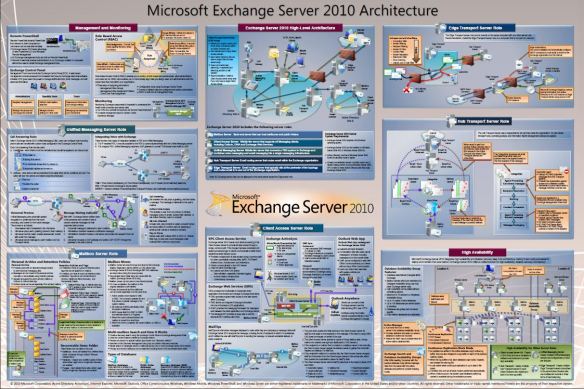
Exchange Server 2010 Architecture poster


Finally, the long awaited Exchange Server 2010 Architecture Poster is here!

This is similar to the Exchange 2007 Component Architecture poster and contains the architecture highlights and feature set of Microsoft Exchange Server 2010. This architecture poster is additional to the already published Microsoft Exchange Server 2010 Transport Server Role Architecture Diagrams which you could already get here.

You can download the Microsoft Exchange Server 2010 Architecture poster here.

Exchange 2010 SP1 Help Updated


The Exchange 2010 SP1 help file has been updated (October 14th, 2010). You can download it here.

The offline reference material is nice to take with you when you can’t access online resources.