
Exchange admins & PowerShell


imageMany people I encounter in the field of Office 365 or Exchange have an infrastructure background. That is, they know a lot about their product(s), how to make it work (or don’t), how to manage, deploy or troubleshoot, etcetera.

Then there is, the let us call it, the reality check of the cloud era, with a roller coaster of cloud-originating developments. This requires a different management focus for these products, resulting in products architected for scale, and introducing configuration and management instruments primarily designed to be ready for automation and operate on scale as well. PowerShell support in Microsoft products is such an instrument.

The introduction of PowerShell required folks with an infrastructure background to develop a new skill: instead of clicking buttons in an interface, they should also become a PowerShell practitioner. Not necessarily wizard level, but at least they need to know their way around when managing their environment using PowerShell, reading and interpreting scripts provided by Microsoft or other vendors prior to usage, or even make changes to make those scripts fit for their own environment.

Writing scripts is another matter. This requires a tad different mindset, where you make repeatable tasks repeatable (time-saving), less prone to error (job-saving), and reusable by your coworkers or even the community who may need to perform the same task. Of course, everybody also expects your scripts to be generic (no hard-coded elements), robust and resilient, adding 90% more code (a bit exaggerated, but you get the idea).

What most of administrators struggle with, is making the connection between managing the product using PowerShell, and how to start using PowerShell to develop their own set of scripts or tools to automate tasks their environment. Administrators wanting to learn such skills will usually find is great books about the product, and great books on learning (generic) PowerShell. Of course, existing scripts found using their favorite search engine can also be a great starting point, provided somebody already developed it for the task you are trying to accomplish.

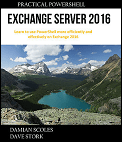
With the Exchange Server 2016 administrator in mind, Exchange fellows Dave Stork and Damian Scoles tried to bridge that gap with their book, Practical PowerShell: Exchange Server 2016. It uses some practical Exchange-themed examples, how to approach the problem, and how to go from running a few cmdlets in sequence to developing small scripts which operate against one or multiple servers. Also, while this book aims at the on-premises Exchange administrators, the skills learned are not lost when the organization moves to Exchange Online as these scripting skills are compatible.

Knowing how difficult it can be to transfer knowledge to paper from my own experience, I think Dave & Damian did a respectable job. The timing of the book release is also interesting, as the product which introduced PowerShell to so many of us, Exchange Server 2007, is going End of Life soon, on April 2011, 2017 to be exact. Realizing PowerShell has been around now for so many years, there is no excuse to get your PowerShell skills going, unless you want to share the faith of dinosaurs.

More information on the book, including a sample chapter, is available at https://www.practicalpowershell.com. You can also order the book from Amazon here.

Exchange and VMWare Guest Introspection


Ex2013 LogoIn this long overdue article, I would like to share an experience, where a customer was upgrading from Exchange 2010 to Exchange 2013. Note that this could also apply to customers migrating from Exchange 2007 or migrating to Exchange 2016 as well. The Exchange 2013 servers were hosted on VMWare vSphere 5.5U2; the Exchange 2010 servers on a previous product level.
The customer saw a negative impact on the end user experience of Outlook 2010 users, especially those working in Online Mode. Other web-based services like Exchange Web Services (EWS) were affected as well. The OWA experience was good.

Symptoms
After migrating end user mailboxes from Exchange 2010 to Exchange 2013 (but as indicated, this applies to Exchange 2016 as well), end users reported delays in their Outlook client responses, where sometimes Outlook seemed to ‘hang’ when performing certain actions like accessing a Shared Mailbox. Also, when opening up the meeting planner in order to schedule a room using Scheduling Assistant, it could take a significant amount of time, (i.e. minutes) before the schedule of all the rooms was being displayed.

The end users’ primary mailbox was configured to use Cached Mode, except for VDI users who used their primary mailbox in Online Mode. Shared Mailboxes were used in Online Mode due to the size (Outlook 2010, so no slider).

Analysis
First, the overall health of the Exchange environment was checked to exclude it as a potential cause. Exchange performance metrics were monitored, as well as Managed Availability status and events, logs like the RCA logs, and VMWare CPU Ready % to check for potential vCPU allocation issues (read: oversubscription). None of these metrics caused any reason for concern.

After reconfiguring the HOSTS file, in order to bypass the load balancer and direct traffic to a single Exchange server to simplify troubleshooting, the symptoms remained. Then, we checked:

  • TCP/IP optimization settings, e.g. RSS, Chimney, etc.
  • VMWare VMXNet3 offloading, e.g. Large Send Offload, TCP Checksum Offloading
  • VMWare VMXNet3 buffer settings

All those settings were also found to be on their recommended values.

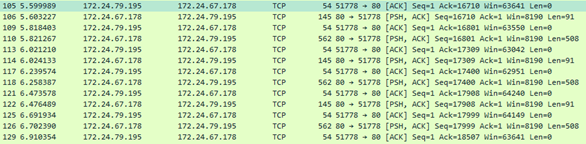
We started digging in from the client’s perspective, and used WireShark to see what was going on on the wire. After filtering on the Exchange host, we saw the following pattern:

image

Note that this customer used SSL Offloading, so mailbox access took place on port 80 instead of 443 (RPC/http).

As you might notice, there is a consistent 200ms delay after the client receives its response (e.g. packets 106 and 110). When searching around for ‘200ms’ and ‘delay’, you may end up with articles describing the effect of the Nagle algorithm (Delayed ACK). Nagle is meant to reduce chatter on the wire, but can have a negative effect on near real-time communications, especially with small packets. Also, while 200ms might seem small, looking at the number of packets exchanged between Outlook and Exchange, this can add up quite quickly. Most of these articles will also describe a fix, recommending to configure a registry key TcpAckFrequency, and set it to 1 (default is 2). For testing purposes, we configured this key and after the mandatory reboot, the end user Outlook experience was snappy. However, setting this key would impact all client communications (real as well as VDI clients); not a recommended long-term solution due to side effects on the network.

After removing the registry key, investigating was continued. Since there was no issue with the Exchange 2010, we started to suspect there was perhaps an issue with VMWare, or there was some form of network optimization or packet inspection going on. This, due to the fact there was no problem with the old Exchange environment, and the elements that changed when migrating were VMWare vSphere version, physical vSphere hosts, and last but not least, the protocol switched. This client didn’t use Outlook Anywhere, so RPC/http was not enabled for Exchange 2010 prior to migration, and clients connected using MAPI. After some more investigating, some potentially related articles on the VMWare knowledgebase were found, talking about latency issues in certain VMWare Tools versions, the VMWare guest driver set, and downgrading these to 5.1 would have the same effect as configuring TcpAckFrequency. Unfortunately, this wasn’t an option as the hardware level of the VMWare guests already was on a certain level.

introRemediation
When installing VMWare Tools, the package comes with some system-level drivers which handle communications between the guest and the host or other guests. One of these drivers is the VMWare Guest Introspection driver (or VMCI Drivers, and formerly VShield Drivers). This component can be identified in the guest in the presence of the system drivers vnetflt and vsepflt, and accommodates agentless antivirus solutions like McAfee MOVE. However, it seems to also interfere with certain workloads in their driver ecosystem, thus negatively impacting real-time communications. I wasn’t able to test if the change from MAPI to RPC/http (or later MAPIhttp) also contributed to this effect, as the Introspection driver may not scan MAPI RPC packets at all, in which case there is no overhead introduced.

Needless to say disabling the Guest Introspection component might be less desirable for some organizations, and in those cases, when you experience this issue, I suggest contacting your VMWare representative, after verifying your VMWare Tools are part of the list of recommended versions.

In the end, in this situation Guest Introspection was disabled and a file-level scanner was introduced (with the required exclusions, of course). Performance for Online Mode was optimal when accessing Online Mode mailboxes, and using Exchange web services like Scheduling Assistant showed room planning in seconds rather than minutes.

image.pngNote that unfortunately, recent versions of VSphere running Exchange virtualized workloads also have this issue. On the plus side, they allow for separate (de)installation of the file system driver (NSX File Introspection Driver) and the network driver (NSX Network Introspection Driver). I am pretty sure removing the network driver would suffice, which might be a viable solution for some folks as well.

If you have any insights to share, please leave them in the comments.

Results Install-Exchange15 survey


stats chartA short blog on a small survey I’ve been running for some time now on the usage of Install-Exchange15, the PowerShell script for fully automated deployment of Exchange 2013 or Exchange 2016.
I started the survey because I was curious on a few things:

  • How the script is used; do folks use it for deploying in lab environments, or also actual production environments.
  • What Exchange versions are deployed; only current ones (n-2 at most, i.e. lagging 2 Cumulative Update generations at most), or also older versions.
  • What operating systems are used to deploy Exchange using this script.

The second and last items are of most interest, as keeping backward compatibility in the script, for example like deploying Exchange Server 2013 SP1 on Windows Servers 2008, requires keeping a lot of ‘legacy code’ in there.

Fortunately, the survey shows many of you use the script to deploy recent Exchange builds on current operating systems. So, in time, you will see support for older builds and operating systems being removed, making the script more lean and mean as well.

Now, on to the results:

In what environments do you use the script to deploy Exchange?

Lab

Production

Yes

86%

72%

No

14%

28%

Do you use Install-Exchange15.ps1 for previous (N-2 or older) Exchange 2013/2016 builds?

Yes 28%
No 72%

On which Operating Systems do you deploy Exchange 2013/2016? (multiple options possible)

Windows Server 2008 0%
Windows Server 2008 R2 18%
Windows Server 2012 18%
Windows Server 2012 R2 100%
Windows Server 2016 8%

Finally, a summary of the feedback and requests send in by respondents through the open comments section:

  • Installation on Windows Server 2016. The survey was created before Windows Server 2016 was supported, so we used the feedback given on people deploying on WS2016 in the above results.
  • In general, positive feedback on having this script for automated deployment, as well as the SCP feature.
  • Request for having a GUI to create the answer file.
  • Request to having the option to configure the virtual directories after installation. However, the script allows for inserting custom (Exchange) cmdlets in its post-configure phase.
  • Request to output cause of failed Exchange setup to the screen. That however, is something I wouldn’t recommend; the Exchange setup log files contain the details.
  • Request to have some sort of visible clue if the installation was successful or not.

A short 2016 retrospective


oscarFirst of all, happy new year to all dear readers and followers. With January well underway, and taking some (largely offline) time off for the holiday period, it’s time to see what 2016 brought.

But first a new year resolution: step up the blogging game. While there isn’t much development happening in the Exchange space, with Microsoft’s cloud-first strategy, there is still a lot to talk about or script for. My list list of ‘scripting ideas’ is substantial, now let’s find some time to realize some of these ideas. Knowing that when you publish scripts, you automatically become its support channel, so that may put some additional stress on my mailbox, but it’s a small price for helping lots of people out.

Some Highlights:

  • Re-awarded as Office 365 Servers and Services MVP
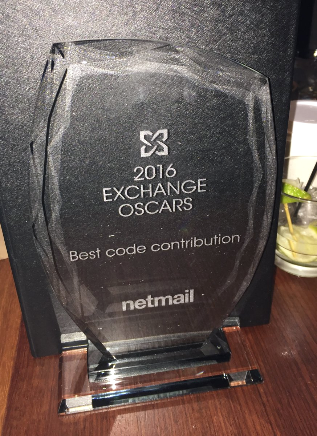
  • Awarded 2016 Exchange Oscar for Best Code Contribution
  • Workshop: Advanced PowerShell Management of Office 365
    IT/Dev Connections
  • Webinar: How to Benefit from MS Office 365 and Maintain Control of Your Data
  • Session: Exchange 2016 & OOS, Office Online Server

Global Stats of 2016:

  • Number of views: 309,767 (total: 1,888,669)
  • Visitors: 220,900 (total 894,316)
  • Number of posts: 22 (total 547)

Popular Posts of 2016:

Note: Not considering the Archives, Versions, Builds and Dates, Schema Versions and Toolkit pages.

  • Exchange ActiveSync and Inheritable Permissions issue
  • TargetAddress, ExternalEmailAddress and Set As External
  • The Attribute, the Myth, the legacyExchangeDN
  • Limiting Exchange 2010 Database Cache
  • Outlook for iOS adds Contacts support

Top 5 Visitor Countries of 2016:

  • United States (96,286)
  • United Kingdom (29,606)
  • Germany (19,968)
  • India (14,355)
  • Netherlands (13,056)

image

Top 5 Referrers of 2016:

  • exchangeserverpro.com (Paul Cunningham’s)
  • blogs.technet.com (MSFT blogs)
  • meridian.ws (blog)
  • experts-exchange (community)
  • veritas.com (support forum)

Top 5 Search Terms of 2016:

  • kb2506143
  • targetaddress
  • federation information could not be retrieved from the external organization
  • exchange 15.1
  • exchange version numbers

Top 5 Scripts of 2016:

  • Ignite 2016 Slidedeck and Video downloader (4,941, total 4,941)
  • Exchange v15 (2013/2016) Unattended Installation Script (2,601, total 8,577)
  • Removing Duplicate Items from a Mailbox (2,079, total 6,843)
  • Clearing AutoComplete and other Recipient Caches (1,932, total 3,920)
  • Removing Messages by Message Class from Mailbox (915, total 2,942)

Exchange Server Role Requirements Calculator 8.4


Exchange 2010 Mailbox Role Sizing Calculator 16.4Last week, the Exchange team published an update for the Exchange Server Role Requirements Calculator, the tool to aid you in properly sizing your Exchange Server 2013 or Exchange Server 2016 deployments.

The new version number is 8.4, and it contains the following changes since version 8.3:

New Functionality

  • Added support for ReplayLagMaxDelay
  • Added support for SafetyNetHoldTime in CreateDAG.ps1

Bug Fixes

  • Improved the DAG auto-calculation results display to highlight deployment configuration in both datacenters
  • Fixed an issue that prevented DAG auto-calculation in single site DAG deployments
  • Fixed a SPECInt2006 validation issue with DAG auto-calculation
  • Fixed a bug with the DAG auto-calculation with Active/Passive deployments
  • Fixed conditional formatting issues with the transaction log table
  • Removed data validation from certain unused cells on the Input tab
  • Fixed bug in calcNumActiveDBsSF formula

You can download the calculator here. For more information, please consult the list of changes here or Read Me here.