Security Updates Exchange 2013, 2016 & 2019


Ex2013 LogoUpdate 14jan: Added Exchange 2010 SP3 RU25

A quick heads-up as during my vacation Microsoft released security updates for supported releases of Exchange Server 2013, 2016 as well as Exchange Server 2019. In addition, a new Rollup was released for Exchange 2010 as well, containing one of the security updates.

The security updates patch issues as reported in the following Microsoft Common Vulnerabilities and Exposures:

  • CVE-2019-0586: Microsoft Exchange Memory Corruption Vulnerability
  • CVE-2019-0588: Microsoft Exchange Information Disclosure Vulnerability

You can download the security updates here:

Notes:

  • Exchange 2010 SP3 RU25 addresses CVE-2019-0588 only.
  • KB4471389 supersedes KB4468741 and KB4459266; KB4468742 supersedes KB4458321.

Be advised that the Security Updates for Exchange 2013 and 2016 are Cumulative Update level specific. Unfortunately, the security update carries the same name for different CU’s, and you cannot apply the update for Exchange 2016 CU10 to Exchange 2016 CU11. I would suggest tagging the Cumulative Update in the file name when you archive it, e.g. Exchange2016-KB4471389-x64-en-CU10.msp.

As with any patch or update, I’d recommend to thoroughly test this in a test and acceptance environment first, prior to implementing it in production.

Security Updates for Exchange 2016, 2013 and 2010


Ex2013 LogoA quick heads-up as during my vacation Microsoft released security updates for supported releases of Exchange Server 2016 and 2013 as well as Exchange Server 2010.

The security updates patch issues as reported in the following Microsoft Common Vulnerabilities and Exposures:

  • CVE-2018-8302 Microsoft Exchange Memory Corruption Vulnerability
  • CVE-2018-8374 Microsoft Exchange Server Tampering Vulnerability (Exchange 2016 only)

You can download the security updates here:

Notes:

  • Be advised that Exchange 2010 SP3 Rollup 23, like recent Cumulative Updates of Exchange 2016 and 2013, requires Visual C++ Redistributable Packages for Visual Studio 2013 (download).
  • KB4340731 supersedes the previous security update KB4092041 for Exchange 2016 and Exchange 2013.

Be advised that for Exchange 2013 and 2016, Security Updates are Cumulative Update level specific. While the downloaded security updates may carry the same name, the files are different and you cannot apply the downloaded security update file for Exchange 2016 CU8 to Exchange 2016 CU9. I suggest adding some form of identification of the Cumulative Update to the file name when you archive it, e.g. Exchange2016-KB4340731-x64-en-CU10.msp.

As with any patch or update, I’d recommend to thoroughly test this in a test and acceptance environment first, prior to implementing it in production.

MVP’s around the World


mvpUpdated July 3rd:  Includes newly registered awardees and awardees who changed category. Added overview of Office Servers and Services numbers over last couple of years.

With the latest annual award cycle, one might be curious which impact it had on the MVP population. I performed a similar exercise last year to compare the impact of the start of the new award cycle. This year, all the MVP’s previously on the January and October cycles were also included in the reviews, making this year the first one where MVP leads and others had to perform the dauntless task of reviewing community contributions of over 3,500 people.

For comparison, I had a look at the public MVP statistics of July 1st against those of June 26th, to exclude significant noise from the monthly awardees. To start, let us first have a look at the total population of MVP’s. From the numbers, it is clear some type of correction took place, as the total number of MVP’s went down from 3,815 last month to 3,025 now (-21%).

As big changes might be a result of change of focus, the following table contains the changes per award category from June 2018 to July 2018. Note that the total number of MVP’s doesn’t equal the total number of awardees, as people can be awarded in more than one category; there are 50 MVP’s with multiple award categories.

Competence Jun2018 July2018 Change
Access 39 29 -26%
AI 28 58 107%
Business Solutions 221 184 -17%
Cloud and Datacenter Management 410 302 -26%
Data Platform 442 366 -17%
Enterprise Mobility 159 122 -23%
Excel 103 84 -18%
Microsoft Azure 370 368 -1%
Office Development 44 33 -25%
Office Servers and Services 490 383 -22%
OneNote 15 12 -20%
Outlook 14 11 -21%
PowerPoint 40 34 -15%
Visio 15 10 -33%
Visual Studio and Development
Technologies
1043 780 -25%
Windows and Devices for IT 136 87 -36%
Windows Development 273 186 -32%
Word 23 19 -17%
Total 3865 3066 -21%

Except for the AI MVP’s, all the numbers are down. Way down. Word is quite a number of long-standing MVP’s have not been re-awarded this cycle. One could only guess for the motivation (only Microsoft knows), but it could be due to the ongoing shift from on-premises technology to cloud-based technology.

When zooming in on the Office Servers and Services MVP’s category, the awards per country is shown in the following heath map and table. Be advised that MVP’s that are anonymous or have profiles without location (~23 for Office Servers and Services), are not taken into account since their location is unknown.

image

Country Number Country Number Country Number
Argentina 0 (-100%) Ireland 1 (0%) Saudi Arabia 1 (0%)
Australia 17 (-40%) Israel 0 (-100%) Serbia 1 (0%)
Austria 2 (0%) Italy 8 (-20%) Singapore 3 (-25%)
Belgium 8 (0%) Japan 11 (-45%) Slovakia 1 (0%)
Bosnia-Herzegovina 2 (0%) Jordan 1 (0%) Slovenia 1 (-50%)
Brazil 2 (-34%) Korea 6 (-15%) South Africa 4 (-20%)
Bulgaria 1 (0%) Latvia 1 (0%) Spain 5 (-17%)
Canada 29 (-24%) Macedonia F.Y.R.O 2 (0%) Sri Lanka 4 (-43%)
Chile 1 (0%) Malaysia 1 (-50%) Sweden 6 (-25%)
China 14 (-13%) Mexico 2 (-50%) Switzerland 5 (0%)
Colombia 2 (0%) Nepal 1 (0%) Thailand 1 (0%)
Croatia 5 (-17%) New Zealand 4 (-20%) The Netherlands 13 (-8%)
Czech Republic 3 (-25%) Norway 5 (-17%) Turkey 4 (-20%)
Denmark 2 (-50%) Pakistan 2 (0%) Ukraine 1 (-50%)
Egypt 1 (-50%) Peru 1 (-50%) United Arab Emirates 1 (-50%)
Finland 2 (0%) Poland 2 (0%) United Kingdom 23 (-15%)
France 15 (-12%) Portugal 3 (-25%) United States 90 (-19%)
Germany 16 (-20%) Romania 1 (-50%) Uruguay 1 (0%)
Greece 1 (0%) Russia 5 (-50%) Vietnam 0 (-100%)
Hungary 2 (-50%) TOTAL 383 (-22%)
India 12 (-8%)

As shown, some countries have lost their Office Servers and Service MVP’s completely. Looking at the total number of Office Servers and Services MVP’s over the year, the number went a little up again due to monthly awardees, but with the July cycle, the number of Office Servers and Services MVP’s went from 490 to 383 (-22%).

The number of Office Servers and Services and total number of MVP’s over the last years (since award restructuring).

Month oct2016 jan2017 jun2017 jul2017 jan2018 jun2018 jul2018
OSS 538 505 (-7%) 532 (+5%) 449 (-16%) 480 (+6%) 490 (+2%) 383 (-21%)
Total N/A N/A 4134 3490 (-16%) 3747 (+7%) 3815 (+2%) 3030  (-21%)

Unfortunately, I have no data on the other categories from before june 2017.

If you have questions or comments, please discuss in the comments.

2018-2019 Microsoft MVP Award


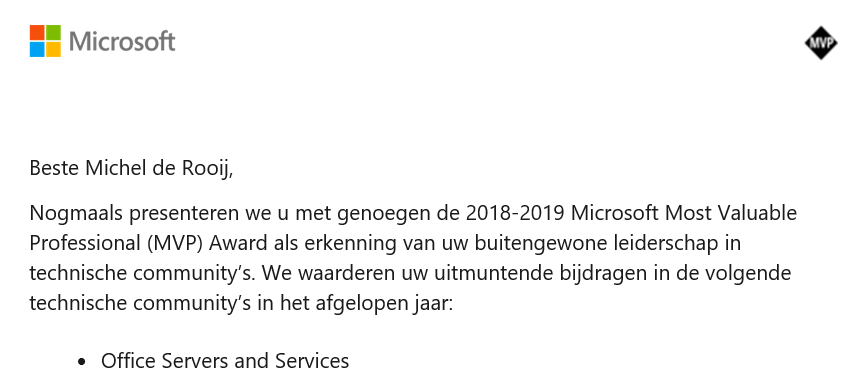
With great joy and honor I can announce that I have been awarded the Microsoft Most Valuable Professional Award in the category Office Servers and Services (localized e-mail):

image

MVP awards are given to individuals by Microsoft in recognition of their contributions to the community, such as:

  • Writing blogs, articles, books.
  • Speaking engagements or podcasts.
  • Supporting others, e.g. forum or TechCommunity contributions.
  • Code contributions.
  • Product feedback.

This is my 5th consecutive year as an MVP. I used to be an “October MVP”, which meant my award was up in October every year. After the award cycle changed to a yearly one for everyone, this year was the first time all MVP’s who fell under the old quarterly cycles, were being up for renewal. It also meant, contributions of a longer period of time were being evaluated. So lots of kudos to the MVP leads and other folks that had to go through the monstrous task of reviewing thousands of contributions for this cycle.

Many thanks to the community, readers, followers, fellow MVP’s and friends, peers, product groups and other Microsoft employees for their encouragement, inspiration and support over all those years.

My MVP profile can be found here.

Exchange Updates – June 2018


Ex2013 LogoThe Exchange Team released the June updates for Exchange Server 2013 and 2016, and an additional Rollup 22 for Exchange Server 2010 Service Pack 3.

Apart from fixes and time zone changes, these updates contain the following important changes and notes:

  • As announced earlier, Exchange 2013 CU21 and Exchange 2016 CU10 require .NET Framework 4.7.1.
  • All three updates require the VC++ 2013 runtime library, because it is needed by a 3rd component in WebReady Document Viewing in Exchange 2010/2013 and Data Loss Prevention in Exchange 2013/2016. Exchange 2010 SP3 RU22 will force installation of this VC++ runtime.
  • Updates include a critical security patch for Oracle Outside In libraries. More about the issue in MSRC advisory ADV180010.
  • Exchange 2013 CU21 and Exchange 2016 CU10 introduce support for directly creating and enabling remote shared mailboxes, e.g.
    New-RemoteMailbox [-Shared] [-Name remoteMailboxName]
    Enable-RemoteMailbox [-Identity user] [-Shared] [-RemoteRoutingAddress user@domain]
    Set-RemoteMailbox [-Name user] [-Type Shared]

    You need to run setup /PrepareAD to see these changes. More information in KB4133605.

  • This is the last planned Cumulative Update for Exchange 2013 as it enters Extended Support.
  • Exchange 2010 SP3 RU22 adds support for Windows Server 2016 Domain Controllers.


Version Build KB Article Download UMLP Schema Changes
Exchange 2016 CU10 15.1.1531.3 KB4099852 Download UMLP No
Exchange 2013 CU21 15.0.1395.4 KB4099855 Download UMLP No
Exchange 2010 SP3 RU22 14.3.411.0 KB4295699 Download

Exchange 2016 CU10 fixes:

  • 4056609 Event ID 4999 and mailbox transport delivery service won’t start with Exchange Server 2016 CU7 installed
  • 4133605 Cmdlets to create or modify a remote shared mailbox in an on-premises Exchange environment
  • 4133620 “HTTP 500 due to ADReferralException” error when a user tries to view detail properties of mailboxes in a child domain in Exchange Server
  • 4095974 “System.InvalidOperationException” occurs when the “Enable-MailPublicFolder” cmdlet is run against a public folder in Exchange Server
  • 4095973 Set-ServerComponentState cmdlet does not honor the write scope defined in the RBAC management scope in Exchange Server
  • 4095993 HTTP 500 error when an administrator tries to manage regional settings in ECP on Windows Server 2016
  • 4294209 Cannot clear the “Maximum message size” check box for Send messages or Receive messages in EAC in Exchange Server 2016
  • 4294208 “TooManyObjectsOpenedException” error when you run the “Get-PublicFolderMailboxDiagnostics” cmdlet in Exchange Server
  • 4294212 Cannot send VBScript-created messages in the Outlook 2016 client
  • 4294211 Cannot run “Set-CalendarProcessing” cmdlets after you apply CU8 or CU9 for Exchange Server 2016
  • 4294210 Cannot edit an email attachment in OWA in an Exchange Server 2016 environment
  • 4294204 Changing “IsOutOfService” to “False” in an earlier Exchange Server version does not immediately update in a later Exchange Server environment
  • 4092041 Description of the security update for Microsoft Exchange Server 2013 and 2016: May 8, 2018

Exchange 2013 CU20 fixes:

  • 4133605 Cmdlets to create or modify a remote shared mailbox in an on-premises Exchange environment
  • 4133604 User can’t log on to a POP/IMAP account by using NTLM authentication in Exchange Server 2013
  • 4133618 Unexpected error occurs when running the Get-DatabaseAvailabilityGroupNetwork cmdlet in Exchange Server 2013
  • 4133620 “HTTP 500 due to ADReferralException” when a user tries to view detail properties of mailboxes in a child domain in Exchange Server
  • 4058473 An Office 365 primary mailbox user cannot be assigned full access permissions for an on-premises mailbox in Exchange Server
  • 4094167 The MSExchangeRPC service crashes with a System.NullReferenceException exception in Exchange Server 2013
  • 4095974 “System.InvalidOperationException” occurs when the “Enable-MailPublicFolder” cmdlet is run against a public folder in Exchange Server
  • 4092041 Description of the security update for Microsoft Exchange Server 2013 and 2016: May 8, 2018
  • 4294205 POP3 services intermittently stop in an Exchange Server 2013 environment
  • 4294204 Changing “IsOutOfService” to “False” in an earlier Exchange Server version does not immediately update in a later Exchange Server environment

Exchange 2010 Rollup 22 fixes:

  • 4295751 EWS impersonation not working when accessing resource mailboxes in a different site in Exchange Server 2010 SP3

Notes:

  • Exchange 2016 CU8 and Exchange 2013 CU18 do not contain schema changes compared to their previous Cumulative Update. However, they introduce RBAC changes in your environment. Use setup /PrepareAD to apply RBAC changes, before deploying or updating Exchange servers.
  • When upgrading from an n-2 or earlier version of Exchange, or an early version of the .NET Framework, consult Upgrade Paths for CU’s & .NET.
  • When upgrading your Exchange 2013 or 2016 installation, don’t forget to put the server in maintenance mode when required. Regardless, setup will put the server in server-wide offline mode post-analysis, before making actual changes.
  • When using Exchange hybrid deployments or Exchange Online Archiving (EOA), you are required to stay at most one version behind (n-1).
  • If you want to speed up the update process for systems without internet access, you can follow the procedure described here to disable publisher’s certificate revocation checking.
  • Cumulative Updates can be installed directly, i.e. no need to install RTM prior to installing Cumulative Updates.
  • Once installed, you can’t uninstall a Cumulative Update nor any of the installed Exchange server roles.
  • The order in which you upgrade servers with Cumulative Updates is irrelevant.

Caution:

As for any update, I recommend to thoroughly test updates in a test environment prior to implementing them in production. When you lack such facilities, hold out a few days and monitor the comments on the original publication or forums for any issues.