
Exchange 2010 Mailbox Role Calculator 12.3


The Microsoft Exchange Team introduced some serious fixes and additions in the Exchange Mailbox Role Calculator version 12.3. This version includes the following fixes since 7.8:

Additional functionality:

  • Incorporated Megacycle adjustment formula changes mentioned in the Exchange Team blog Guidance Change- Calculating the Megacycles for Different Processor Configurations Formula;
  • The calculator no longer requires you to enter in the adjusted megacycles per core for the server architecture you are deploying.  Instead, you simply need to obtain the SPECint2006 Rate Value for your server platform (consult www.spec.org);
  • Added Megacycle Multiplication Factor – this works exactly like the IOPS Multiplication Feature does and was added as a result of RIM providing E2010 guidance on megacycle impact due to Blackberry devices;
  • Active/Active user distribution scenarios;
  • Added a new worksheet/section that documents the Activation Scenarios for DAG deployments;
  • Added error reporting validation logic if HA solution results in greater than 16 servers in a DAG to not show any results, since the design is invalid;
  • Dumpster size calculations have been optimized as calendar versioning storage has been reduced from 5.8% impact to 3% impact in SP1;

Bug fixes:

  • Fixed Total Number of Databases / Server calculation to deal with scenario where lagged copies are deployed in both datacenters for Active/Active (Single DAG) scenario;
  • Optimized Number of Active Databases after First PDC Server Formula removing redundant bad code and enabling single database scenario;
  • Fixed Number of Required Mailbox Processor Cores for both PDC and SDC calculations to take into account the situation where the required megacycles to support the active load is less than the number of megacycles per core;
  • Optimized Number of Required Mailbox Processor Cores for both PDC and SDC calculations to not assume all required cores would be 100% utilized by changing how rounding works in the formula;
  • Fixed Number of Active Databases / PDC Server (After Second PDC Server Failure) formula to only report a value for the following scenarios: HA Only 3+ HA copies, 4+ servers; HA, Site Resilience, No activation block, 3+ total HA copies, 4+ total servers; HA, Site Resilience, activation block, 3+ PDC HA copies, 4+ PDC servers;
  • Fixed standalone scenario to expose the total number of databases being deployed in the results section when there are multiple servers;
  • Fixed Number of Active database calculations (after first PDC server failure) to take into account activation block;
  • Fixed the Number of active databases during normal runtime formula to round up;
  • Various formatting and text cleanup across all sections;
  • Fixed data error validation statement for IOPS and Megacycle Multiplication Factors to specify the supported value must be 1 or greater.

Consult the changeblog here, including information on the new user distribution models (single/multiple DAGs). You can download the calculator here. Updated usage instructions can be found here.

Exchange 2007 SP3 Rollup 1


Back from a 2 week holiday, so I have some catching up to do.

First up is the release of Rollup 1 for Exchange Server 2007 Service Pack 3 (KB2279665). This update raises Exchange 2007 version number to 8.3.106.2.

Here’s the list of changes included in this rollup (KB2279665):

  1. 2188615 Event ID: 4999 is logged when the EdgeTransport.exe process crashes intermittently on an Exchange Server 2007 server
  2. 2203381 “554 5.6.0 STOREDRV.Deliver; Corrupt message content” NDR is generated when you send an email message to an Exchange Server 2007 user
  3. 2251714 The connecting information is not logged when a user accesses a mailbox that is hosted on an Exchange Server 2007 server by using POP3 or by using IMAP4
  4. 958305 An incorrect user is displayed as the caller in a mail message in an Exchange Server 2007 environment
  5. 973040 The Bcc information is lost when the Exchange Server 2003 journalized messages are sent to an Exchange Server 2007 mailbox
  6. 973637 Exchange Server 2007 creates incorrect Lotus Notes proxy email addresses
  7. 975424 The “legacyExchangeDN” value is shown in the “From” field of an email message instead of the Simple Display Name in an Exchange Server 2007 environment
  8. 975993 “The message could not be opened” error message when an Exchange Server 2007 user tries to open or accept a meeting request
  9. 976100 Shared calendar items are shown incorrectly in the server time zone instead of the time zone of an Exchange Server 2007 user who is accessing the shared calendar
  10. 977189 The meeting time of a meeting forward notification is incorrect on an Exchange Server 2007 server
  11. 978144 A warning message is received when you run the Test-ReplicationHealth cmdlet on an Exchange Server 2007 server
  12. 978468 You receive an error message and Event ID: 1008 is logged when you move an Exchange Server 2007 mailbox
  13. 979038 A memory leak occurs in the Microsoft.Exchange.Monitoring.exe process when you run the Test-OwaConnectivity cmdlet or the Test-ActiveSyncConnectivity cmdlet in Exchange Management Shell on an Exchange Server 2007 server
  14. 979194 Excluding domain names from the Sender ID filter does not take effect after you run the Set-SenderIDConfig cmdlet on an Exchange Server 2007 server
  15. 979338 Fax communication sessions are dropped by an Exchange Server 2007 Unified Messaging server
  16. 979519 The PR_REPORT_TEXT property represents an incorrect read notification in Exchange Server 2007
  17. 979803 Internet Explorer unexpectedly focuses on an Exchange Server 2007 user’s OWA inbox or on an OWA calendar that is added as a web part on a SharePoint Server-based website
  18. 980205 Public folder replication is blocked unexpected in an Exchange Server 2007 environment
  19. 980301 The Microsoft Exchange Information Store service stops responding during a Volume Shadow Copy Service backup on an Exchange Server 2007 server
  20. 980404 A multibyte character is converted into a “0xFFFD” character or into unrecognized characters when you use Exchange Web Services in an Exchange Server 2007 environment
  21. 980725 You experience issues when you move messages from one mailbox folder to another mailbox folder in an Exchange Server 2007 environment
  22. 980914 A user does not receive any new email messages by using a third-party POP3 client in a mixed Exchange Server 2007 and Exchange Server 2003 environment
  23. 980953 A second dot is added to the file names of the automatic generated attachments on an Exchange Server 2007 SP2 or later version server
  24. 981794 The Get-AgentLog cmdlet operation stops and you receive an error message Exchange Server 2007
  25. 982055 The store.exe process crashes occasionally on an active node when you move the Exchange Virtual Server from an active node to a passive node in an Exchange Server 2007 cluster environment
  26. 982099 Unexpected issues occur after you run the Set-mailbox cmdlet on an Exchange Server 2007 server to convert a shared mailbox into a regular mailbox
  27. 982118 The VSS backup operation fails occasionally and Event ID: 2034 is generated on an Exchange Server 2007 server
  28. 982213 The display name or the address of a user is displayed in garbage characters when you reply to an email message in an Exchange Server 2007 environment
  29. 982475 The inline image of an email message that is sent by using OWA with S/MIME enabled is lost for an Exchange Server 2007 user
  30. 982542 Attachments of certain email messages disappear at the client-side when you use an ExOLEDB-based application to change email messages in an Exchange Server 2007 environment
  31. 982722 It takes a long time to copy or move items from one public folder to another public folder by using Outlook in an Exchange Server 2007 environment
  32. 982928 The Msftesql.exe process continues using memory on an Exchange Server 2007 server
  33. 983296 Exchange ActiveSync crashes on an Exchange Server 2007 server causing the client synchronization to be unavailable
  34. 983447 A NDR is not generated when an email message is not delivered after you set the value for “Maximum number of recipients” of “Transport Settings” to “0” on an Exchange Server 2007 server
  35. 983529 The EdgeTransport.exe process crashes and then restarts on an Exchange Server 2007 server
  36. 983540 “Http 500” error message when you use Exchange Troubleshooting Assistant on an Exchange Server 2007 Client Access server to diagnose issues

As the Exchange Team mentioned, when running ForeFront Protection for Exchange, make sure you disable ForeFront before installing the rollup and re-enable it afterwards, otherwise the Information Store and Transport services may not start. You can disable ForeFront using fscutility /disable and enable it by using fscutility /enable

You can download Exchange 2007 SP3 Rollup 1 here.

Decommisioning a DAG member


While I was at it, I thought I might as well blog about it. In the situation you need to dismantle an Exchange 2010 DAG member, proceed as follows:

  1. Start up Exchange Management Console (ofcourse you can do this from the Exchange Management Shell as well,  but in this example I’ll use EMC);
  2. Go to Organization Configuration > Mailbox > Database Management;
  3. Select the database where ” Mounted on Server” reads the server you’re decommissioning;
  4. Select Move Active Mailbox Database;
  5. Select the Mailbox server to host the  mailbox database copy and select Move;
  6. When the move has finished, select the database copy hosted on the server you want to decommission in the lower pane. There, select Remove.
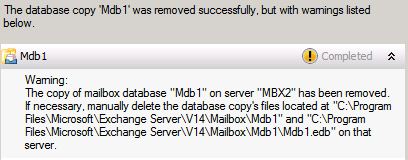
  7. When finished you’re greeted with a warning message. That is because the copy has been removed, but the files are still present. Remove them manually when required;
  8. Next, we need to remove the server from the DAG. Select tab Database Availability Groups;
  9. Select the DAG the server is a member of and select Manage Database Availability Group Membership;
  10. Select the server and click the red cross to remove it from the list. Click Manage to proceed with the actual removal;
  11. When finished the mailbox server is no longer member of the DAG.

You can then proceed with uninstalling Exchange. Note that you can only remove DAG members of a healthy DAG.

ForeFront Update Center


Want to check if you’re running the latest Service Pack or Rollup for your ForeFront components? The ForeFront team has published a page where all ForeFront components, related technologies included, are listed, including information on the latest Service Pack, Rollup, version number as well as a link to product guidance.

The ForeFront Update Center as it is called contains information on the following products:

  • Microsoft Forefront Protection 2010 for Exchange Server
  • Forefront Protection 2010 for SharePoint
  • Microsoft Forefront Client Security
  • Microsoft Forefront Security for Exchange Server
  • Forefront Security for SharePoint
  • Forefront Server Security Management Console
  • Forefront Security for Office Communications Server
  • Antigen 9.0 for Exchange
  • Antigen 8.0 for Microsoft SharePoint Portal Server
  • Forefront Threat Management Gateway 2010
  • Internet Security and Acceleration Server 2006
  • Forefront Unified Access Gateway 2010
  • Intelligent Application Gateway 2007

You can find the page here.

Performance Analysis of Logs 2.0


In December I blogged about a nice performance analyzing tool called Performance Analysis of Logs or PAL. PAL might be of use in situations when you don’t have advanced monitoring tools like SCOM or when you want to easen the tedious task of cycling through generating performance logs, collecting them, and finally use performance monitor to analyse those logs to zoom in on performance issues.

That was version 1.3x, which didn’t have Exchange 2010 support at the time.

Yesterday PAL creator Clint Huffman released version 2.0, which includes Exchange 2010 support. Unlike the earlier version, this version is basically a GUI to generate PowerShell scripts which do the job for you. Therefor, it requires PowerShell 2.0 or greater. Be advised that for to function, the PAL installer will set the PowerShell execution policy to unrestricted to allow execution of PowerShell scripts. Check with your company policy if that is allowed.

You can download Performance Analysis of Logs 2.0 here.

Note that Mike Lagase, who maintained the Exchange treshold files for PAL 1.x, has released a similar tool called PerfWiz which supports Exchange 2007 and Exchange 2010 You can read about that on Mike’s blog here.